Trends: Companies Expanding Maternity/Paternity Leave Policies

Netflix 2014 logo (Under Consideration)

Netflix 2014 logo (Under Consideration)

A very positive trend has sprung up recently: Companies are their expanding parental leave policies. The main goal is to recruit more women with work-life balance policies, and to retain talent by allowing time off for family matters. Because trouble at home often means distracted employees and lower productivity. (I feel like that’s on a modern-day Mather Work Incentive poster somewhere.)

Big strides have been made this year: Consulting powerhouse Accenture bumped up its maternity leave policy to 16 weeks in March, which applies to both full-time and part-time employees. In April, Johnson & Johnson announced a new eight-week paid leave policy. In June, major bank Goldman Sachs began offering new fathers and “non-primary caregivers” four weeks of paid leave. (The company currently offers 16 weeks of paid maternity leave.) The U.S. Navy and Marines mandated an 18-week maternity leave policy, effective immediately, in July.

This trend has become especially prevalent in the tech industry, with a lot of changes occurring just this past month. In August, Microsoft recently announced a new parental leave policy, in which employees would get paid at 100% of their salary for 12 weeks. New mothers will have eight weeks of paid maternity leave, which, combined with disability leave, could entitle them to 20 weeks of paid leave.

Adobe’s policy also changed: Mothers will now receive 26 weeks of paid leave, up from the nine weeks off from the previous policy. It’ll be a combination of medical leave (10 weeks) and paternal leave (16 weeks).

Netflix announced they’re bumping up their maternity and paternity leave policies to an unlimited amount of time. New mothers and fathers are allowed to take as much time off as they like during a child’s first year, whether though birth or adoption. (Netflix isn’t a stranger to expanding time off: Employees already get unlimited vacation time.) But the policy isn’t all inclusive: It only applies toward salaried employees, so hourly workers aren’t able to take advantage of it.

It’ll be interesting to see if (when) other companies follow suit, and if paid parental leave will eventually be federally mandated. These are definitely steps in the right direction.



Bernie Sanders Essay: How Many Women Have Rape Fantasies?

Bernie Sanders (Crooks and Liars)

Bernie Sanders (Crooks and Liars)

Last week, “Mother Jones” found an essay that presidential hopeful Bernie Sanders wrote in 1972 for alternative newspaper “Vermont Freeman.” Sanders’ two-page essay observed sexual dynamics between men and women.

Here’s the part that got everyone talking:

A woman enjoys intercourse with her man — as she fantasizes being raped by 3 men simultaneously.

Sanders was positing this as a general observation that held true about all women. But is he correct in this assumption?

There’s been some research done on this fantasy.

Last year, researchers at the University of Canada, Quebec asked territory residents about their sexual fantasies and published results in the “Journal of Sexual Medicine.” Though the researchers didn’t directly ask about rape fantasies, they did ask respondents if they agreed with the statement “I have fantasized about being forced to have sex,” which can be construed as such. Over 28% of women agreed with that statement, but it wasn’t enough to hit the “normal fantasy” cutoff (which started at 50% agreement from respondents). The study didn’t examine how often the women had these fantasies.

A 2010 “Psychology Today” article on women’s rape fantasies stated that nine surveys on the topic had been published between 1973 and 2008. Here’s what that collective body of data showed:

They show that about four in 10 women admit having them (31-57%) with a median frequency of about once a month. Actual prevalence of rape fantasies is probably higher because women may not feel comfortable admitting them.

A 2009 study done by North Texas University found that answers depended on what terminology was used. Fifty-two percent of college women said they’d fantasized about being “overpowered by a man,” but only 32% of women agreed when it was labeled “rape.” It’s interesting to note that this range nestles right in the range quoted above.

There also appeared to be an inverse correlation between the number of women who reported having rape fantasies and the frequency with which they had them: 25% of women reported having the fantasy less than once a year, and 13% had the fantasy a few times a year. So while it might be a part of some women’s sexual fantasy playlist, it doesn’t pop up in the rotation with much frequency for those women.

Though Sanders was certainly on to something with his claim, the fantasy isn’t nearly as pervasive (or self-reported) as he made it seem. But Sanders did recognize the desires that that specific fantasy taps into: a woman being overpowered by a man who can’t stop himself from ravishing her. No wonder he recently compared it to “Fifty Shades of Grey.”

UVA Rape Story Retracted: Has It Happened Before?

UVA (Brohammas)

UVA (Brohammas)

Last week, “Rolling Stone” released an investigative report on its now-infamous piece “A Rape on Campus.” The report, produced jointly with the Columbia Graduate School of Journalism, delved into fact-checking the narrative. Ultimately, the investigation found many fact-checking and methodology errors (overall termed a “systematic failing”), and “Rolling Stone” retracted the piece.

I was interested to see if any other investigative journalism pieces, specifically on rape cases, had been retracted at any time. But I wasn’t able to find any. The closest things I could find were examples of victims later recanting their stories.

This has proven to be a first for the journalism world in that such an expansive feature (on such a timely, hot-button issue, no less) has been so thoroughly demolished by its fabrications. Though the story initially drew awareness to rape victims on college campuses, it ultimately ended up casting more negative light on the publication and journalist who covered it. Let’s hope that future journalists covering sexual assault stories will be scared into performing their due diligence to get all the facts right.


How Many College Sexual Assault Investigations Have Been Suspended?

UVA Campus (Brohammas)

UVA Campus (Brohammas)

Yesterday, the Charlottesville, Virginia police announced that they’re suspending their investigation of the UVA fraternity rape allegations due to lack of evidence. After reviewing records and conducting 70 interviews, investigators were unable to find key witnesses or a statement that the assault occurred.

This leads to the obvious question: How many sexual assault investigations have been suspended?

I was specifically interested in the topic in the context of colleges and universities, and searched for that. I was unable to find any conclusive data, which makes sense, as I don’t think schools would be eager to give those numbers out.

The police did say they’re leaving the investigation open, and that it could resume in the future. But I’m sure there are even fewer statistics on re-opened college sexual assault cases.


The UK Introduces “3-Parent Baby” Bill

Human embryos (Bloomberg)

Human embryos (Bloomberg)

Britain made history this week by becoming the first country to introduce a “3-parent baby” bill.

Approved by the House of Commons, the Human Fertilization and Embryology (Mitochondrial Donation) Regulations 2015 seeks to eradicate genetic diseases that are passed from mother to child via defective mitochondria. (Defective mitochondria causes diseases such as brain damage, heart failure and blindness.) The genetic diseases would then cease to be passed to future generations.

For those who aren’t up on their fifth-grade science, here’s how it works: There are two healthy parents, save for the defective mitochondria (the cells that convert food into energy). A third woman would donate her healthy mitochondria via a modified in-vitro fertilization (IVF) technique. From then on, the mitochondria are permanently altered for the better.

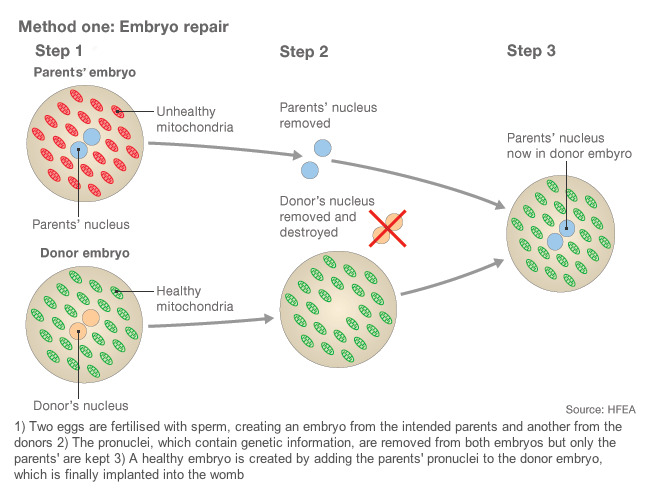
There are two ways the procedure can be executed. For visual learners, diagrams are below:

Method 1 - Embryo Repair (BBC)

Method 1 – Embryo Repair (BBC)

In the first method, the nuclei from the parents’ fertilized embryo is added to the donor’s fertilized embryo. The modified embryo is then placed into the womb.

Method 2 - Egg Repair (BBC)

Method 2 – Egg Repair (BBC)

In the second method, the nucleus from the mother’s egg is placed into the donor egg, with the healthy mitochondria.

In fact, calling a resulting baby from the procedure a “3-parent baby” is a misnomer: The donor would only give about .1% of her DNA. It would only change the portion that houses the genetic disease. Per the BBC, reproductive ethicist Dr. Gillian Lockwood notes:

Less than a tenth of one per cent of the genome is actually going to be affected. It is not part of what makes us genetically who we are. It doesn’t affect height, eye colour, intelligence, musicality.

If the measure passes through the House of Lords, the first baby to benefit from this procedure could be born next year.

NPR notes that U.S. agencies, such as the Food and Drug Administration (FDA) have also been looking into the process, since 1-4K American children are born with a mitochondrial disease (numbers per the United Mitochondrial Disease Foundation).

It’s safe to say that Britain will pave the way with how they handle this measure, and the world will be watching (and learning).