Bernie Sanders Essay: How Many Women Have Rape Fantasies?

Bernie Sanders (Crooks and Liars)

Bernie Sanders (Crooks and Liars)

Last week, “Mother Jones” found an essay that presidential hopeful Bernie Sanders wrote in 1972 for alternative newspaper “Vermont Freeman.” Sanders’ two-page essay observed sexual dynamics between men and women.

Here’s the part that got everyone talking:

A woman enjoys intercourse with her man — as she fantasizes being raped by 3 men simultaneously.

Sanders was positing this as a general observation that held true about all women. But is he correct in this assumption?

There’s been some research done on this fantasy.

Last year, researchers at the University of Canada, Quebec asked territory residents about their sexual fantasies and published results in the “Journal of Sexual Medicine.” Though the researchers didn’t directly ask about rape fantasies, they did ask respondents if they agreed with the statement “I have fantasized about being forced to have sex,” which can be construed as such. Over 28% of women agreed with that statement, but it wasn’t enough to hit the “normal fantasy” cutoff (which started at 50% agreement from respondents). The study didn’t examine how often the women had these fantasies.

A 2010 “Psychology Today” article on women’s rape fantasies stated that nine surveys on the topic had been published between 1973 and 2008. Here’s what that collective body of data showed:

They show that about four in 10 women admit having them (31-57%) with a median frequency of about once a month. Actual prevalence of rape fantasies is probably higher because women may not feel comfortable admitting them.

A 2009 study done by North Texas University found that answers depended on what terminology was used. Fifty-two percent of college women said they’d fantasized about being “overpowered by a man,” but only 32% of women agreed when it was labeled “rape.” It’s interesting to note that this range nestles right in the range quoted above.

There also appeared to be an inverse correlation between the number of women who reported having rape fantasies and the frequency with which they had them: 25% of women reported having the fantasy less than once a year, and 13% had the fantasy a few times a year. So while it might be a part of some women’s sexual fantasy playlist, it doesn’t pop up in the rotation with much frequency for those women.

Though Sanders was certainly on to something with his claim, the fantasy isn’t nearly as pervasive (or self-reported) as he made it seem. But Sanders did recognize the desires that that specific fantasy taps into: a woman being overpowered by a man who can’t stop himself from ravishing her. No wonder he recently compared it to “Fifty Shades of Grey.”

By The Numbers: How Many States Require an Ultrasound Viewing Before an Abortion?

WASHINGTON, DC - MARCH 16: Wisconsin Gov. Scott Walker speaks at the 2013 Conservative Political Action Conference (CPAC) March 16, 2013 in National Harbor, Maryland. The American Conservative Union held its annual conference in the suburb of Washington, DC to rally conservatives and generate ideas.  (Photo by Pete Marovich/Getty Images)

WASHINGTON, DC – MARCH 16: Wisconsin Gov. Scott Walker speaks at the 2013 Conservative Political Action Conference (CPAC) March 16, 2013 in National Harbor, Maryland. The American Conservative Union held its annual conference in the suburb of Washington, DC to rally conservatives and generate ideas. (Photo by Pete Marovich/Getty Images)

Earlier this week, Wisconsin Republican governor/maybe-presidential hopeful Scott Walker signed a new law requiring that women who wanted to get abortions be required to get an ultrasound of the fetus before making their decision. Walker’s reasoning was that he wanted women to make informed choices (i.e. choose life!) about their unborn children. (Side note: he also referred to ultrasounds as “a cool thing out there.” I’m not touching that one.)

I wanted to find out how widespread the practice of requiring expectant mothers to view an ultrasound before proceeding with an abortion was. So I turned to trusty source The Guttmacher Institute for some stats.

Number of states that require giving contextual information (i.e. written materials and/or verbal counseling) around the ultrasound: 12

Number of states that require the abortion provider to show and describe the ultrasound: 3

Number of states that require the abortion provider to offer a viewing of the ultrasound if it’s part of the abortion process: 9

The Guttmacher has more numbers on this topic. Personally, I find it fascinating that these laws are essentially banking on the assumed fact that women are ruled by their emotions and are baby-crazy, and so seeing an ultrasound before an abortion would change their minds.

How Has Colorado’s Teen Pregnancy Rate Dropped 40% Within 4 Years?

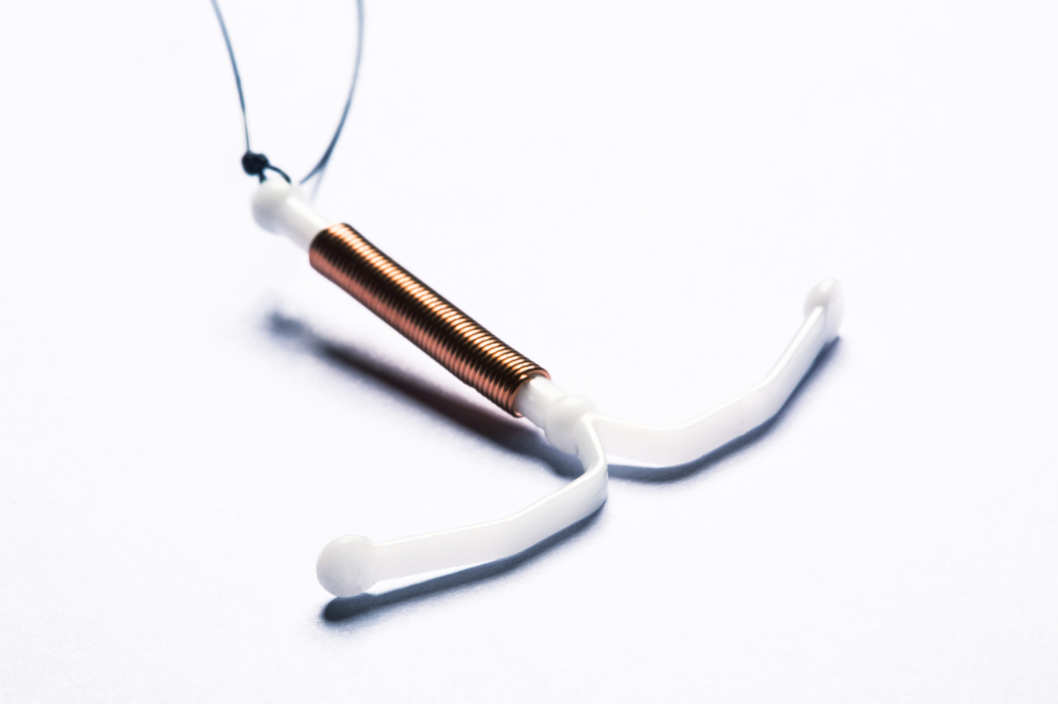
IUD (NY Mag)

IUD (NY Mag)

Colorado’s teen pregnancy rate has been getting some attention recently. But it’s not for the reason you think; it’s actually for the opposite reason.

From 2009 to 2013, Colorado reported a 40% decrease in teenage pregnancies, according to the Colorado Department of Public Health and Environment. Below is a graph that shows the decline:

Colorado's Birth Rate 2005-2012 (The Washington Post)

Colorado’s Birth Rate 2005-2012 (The Washington Post)

That seems insane, right? But there’s actually an interesting reason behind it.

In 2008, an anonymous donor (later revealed to be the Susan Thompson Buffett Foundation, named after Warren Buffett’s late wife) gave a $23 gift to be parceled out over five years. The gift was to be used for “long-term contraception” for low-income teens and women. Over 30K intrauterine devices (IUDs) were purchased and implemented. This measure was rolled out in 68 clinics, as part of Colorado’s Family Planning Initiative.

The IUDs were found to be a very significant factor in the state’s teen pregnancy decline. The study released by the Colorado Department of Public Health and Environment showed that “the percentage of young women receiving IUDs and implants quadrupled in participating clinics,” and, in a complementary effect, the women receiving IUDs accounted for 75% of the state’s overall teen birth rate decline.

On a national scale, Colorado rose from having the “29th lowest teen birth rate in the nation to the 19th.” This is significant as seven in 10 teen pregnancies in the state are unplanned.

The program expires this summer, and it’s unclear whether it will be renewed. But the numbers definitely speak for themselves in terms of effectiveness.


Rome Considers Zone of Tolerance for Prostitutes

Italian prostitutes (The Telegraph)

Italian prostitutes (The Telegraph)

The Roman neighborhood of EUR is considering enacting various “zones of tolerance” around the city within which prostitution would be legal. Certain places would off-limits, such as public parks, churches and schools. This makes sense: A country-wide law dictates that cities can issue boundaries on where prostitution can and cannot occur. This is a bit of a legal loophole in Italy, where aiding prostitution is illegal (but restricting it to certain areas is fine), but paying for sex is totally cool.

Naturally, the prostitutes themselves are not happy with this, as it would cut into their business. The Catholic Church isn’t too pleased either, for obvious reasons.

There are precedents for these zones: In 2012, Montreal was mulling a similar thing, but wanted to restrict it to one street, away from the busy main thoroughfare. In 2006, the English town of Ipswich considered a tolerance zone after a spate of prostitute murders shook the community.

EUR hasn’t come (heh) to a conclusion yet, but it’ll be interesting to see what precedent this sets for the city, Italy and the rest of the world.


How Many States Outlaw Abortion?

Hillary Clinton (ABC News)

Hillary Clinton (ABC News)

With Hillary Clinton’s recent announcement that she’s running for president, women’s issues will be front and center as a talking point this election season. It’s all but certain that one perennially hot-button topic will be brought up: abortion.

Right now, 42 states prohibit abortions, according to a study performed by the Guttmacher Institute. Exceptions can only be made in the case of a threat to the mother’s health. Even then, there are time limits up to which an abortion can be performed. Thirty-nine states require that the procedure be performed by a licensed physician, but health insurance can be a problem: Health care providers can refuse to pay for it in 46 states.

Those are some damning stats, and you can see more in the Guttmacher Institute’s report. Let’s hope this election brings progress and changes to these detrimental policies.

Sofia Vergara’s Frozen Embryos: Is There A Precedent for IVF Egg Custody?

Sofia Vergara (Celebrity Post)

Last week, “Modern Family” actress Sofia Vergara’s former fiancé Nick Loeb penned an op-ed for “The New York Times” regarding Vergara’s frozen eggs. The pair had initially frozen the eggs via in-vitro fertilization (IVF) in case they later wanted children, before their relationship ended last year. (Vergara is currently engaged to “True Blood” actor Joe Manganiello.) Now Loeb wants to unfreeze an eggs to implant within a surrogate, and have a child using his ex-fiance’s egg. (When the two were together, they had signed an agreement regarding using the eggs only with permission from both of them, but there wasn’t any discussion on what might happen if they split.) Vergara, as owner of said egg(s), is (naturally and understandably) refusing to release her eggs.

I wanted to find out of there was a precedent set for IVF egg custody. According to “Chicago Lawyer” magazine, there are no definitive laws or one-approach-fits-all (yet), but 10 states so far have made rules regarding IVF custody and procedure cases.

One big commonality between a lot of these approaches is an issue familiar to sexuality: consent. Courts are generally weighing the desires of each partner, called “balance of interests.” This can be applied if one partner wants to use the eggs, but the other doesn’t want that person to use them. Iowa takes a “co-consent” approach, in that both parties must agree to “sign off when the embryo is implanted in the woman.”

Contracts guide decisions in other states. In these instances, courts rely on “contracts drawn up by the couple before the embryos were created.”  New York, Washington, Texas and Oregon follow this method.

Some states take a blended approach (kind of like a blended orgasm). Tennessee, New Jersey and Pennsylvania first look for existing contracts between both parties before moving on to consent.

Other states are complete outliers in their approach. Iowa has “contemporaneous-mutual-consent,” which is a written agreement that states that both parties must sign off on use of the embryos. Massachusetts is another outlier, stating that the woman receives custody of the embryos in event of divorce.

Vergara and Loeb’s situation may bring attention to this dilemma shared by other ex-couples, and it could drive inquiries and move future legislation forward. We’ll have to see how it plays out.


“Federal Agents Gone Wild:” The Department of Justice Has a Prostitute Problem

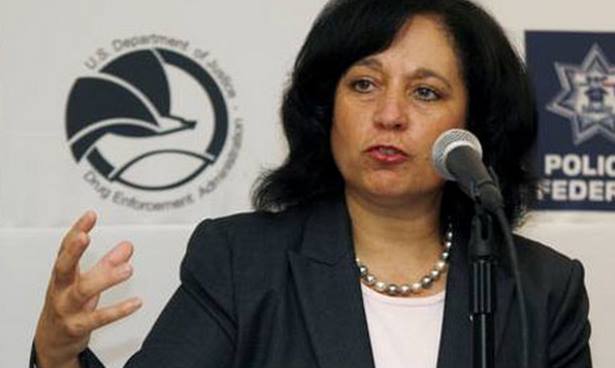
DEA chief Michele Leonhart (Girls Just Wanna Have Guns)

DEA chief Michele Leonhart (Girls Just Wanna Have Guns)

Yesterday, Michele Leonhart announced that she’d resign from her post as chief of the Drug Enforcement Agency (DEA) in early May. This comes after reports surfaced that some male employees were enjoying sex parties with prostitutes which were paid for by drug cartels in Colombia. And it had been going on for years. Conflict of interest much?

Earlier this month, Attorney General Eric Holder had to issue a department-wide memo for Department of Justice employees, reminding them that they are not allowed to solicit prostitutes under any circumstance. His point was that any employee who does this opens up himself, and the agency, to potential blackmail, extortion and leaking private information. (Seems like common sense to me.) I bet he never thought he’d have to write this kind of memo.

I tried to find if there were any other instances of this happening (since it was apparently uncovered during a routine Inspector General report), but couldn’t find anything. All stats I could find were more related to prostitution stats that the DOJ itself had reported on.

It’ll be interesting to watch how this all plays out, and what (if any) further punishments the DOJ partying employees will receive. (So far, employees who’ve confessed have only been suspended, but only up to a week-and-a-half.) It’s one thing to indulge in sex parties off the clock, but it’s another thing entirely to blur professional lines against those you’re supposed to be against (though I’m sure that was part of the appeal).


#ThrowbackThursday: The Comstock Act, 1873

The New York Society for the Suppression of Vice seal (Loyno)

The New York Society for the Suppression of Vice seal (Loyno)

Praise be for mail-order sex toys. We wouldn’t have that option if the Comstock Act was enforced.

Enacted on Mar. 3, 1873, the Comstock Act (named after the bill’s cheerleader/goody-two-shoes Anthony Comstock) made it illegal to send sex toys, erotica, and items used in abortions, as well as information pertaining to said items, through the U.S. Postal Service. All of these things were classified as “obscene, lewd or lascivious.” The full title of the act was “The Act for the “Suppression of Trade in, and Circulation of, Obscene Literature and Articles of Immoral Use”. (What a mouthful, no wonder it was cut down to the Comstock Act.)

But what exactly was banned was a bit confusing. In some cases, medical textbooks showing basic human anatomy weren’t allowed to be sent through the mail. Because of this, the Act was understandably difficult to enforce. Though it remains on the books today, aspects of it have been torn down.

Thank god, because I can’t imagine a world where Adam & Eve, The Pleasure Chest and countless other retailers aren’t allowed to exist and flourish, and send us hours of pleasure packed in a brown-paper-wrapped box labeled with discreet shipping.

Michelle Bachelet Proposes Lifting Chile’s Total Abortion Ban

Chilean President Michele Bachelet (Slate)

Chilean President Michele Bachelet (Slate)

Late last month, Chilean President Michelle Bachelet proposed lifting her country’s total abortion ban.

Chile is one of seven Latin American countries to completely ban abortion. Bachelet’s bill allows for the measure in case of rape, or if the mother and/or baby are at risk of dying during the pregnancy. The procedure would be allowed up until the 12th week (3rd month) of pregnancy, or until the 18th week for girls younger than 14 years of age. Girls ages 14 to 17 would need their parents’ permission for the procedure.

Abortion has been outlawed in Chile since 1989, imposed under former dictator Augusto Pinochet during his rule. Anyone breaking this law faces up to five years in jail. (Before the ban, abortions were allowed in extenuating circumstances.) Twelve bills decriminalizing the procedure have been proposed since 1991, but none (so far) have passed through the country’s Congress.

The measure would cut down the number of women taking chances on risky, “back-street” abortions detrimental to their health. A “Reuters” estimate puts the number of illegal abortions between 15K and 160K. (Since the numbers would have to be self-reported in this case, it’s difficult to get an accurate count.)

According to an interview in Spanish newspaper “El Pais,” Bachelet was originally planning on proposing the bill in late 2014.

Bachelet faces opposition from anti-abortion activists, and from UDI, the opposing political party. Culturally, the country is also very socially conservative, owing to a large Catholic stronghold. But despite this, recent public polls found that 70% of Chileans support the bill.

This isn’t the first time Bachelet has worked to reform family planning: In her first term as president (2006-2010), she made the morning-after pill free in government hospitals available to women ages 14 and older, with parental consent unneeded.

This is one time where I think having a politician make laws about women’s bodies could work: In addition to being a woman, Bachelet is also a registered pediatrician. #FemaleLeadersKnowBest

No Shit: Colleges Are Underreporting Sexual Assaults

UVA Rotunda (Wikipedia)

UVA Rotunda (Wikipedia)

This should come as a surprise to absolutely no one: A recent study published in “Psychology, Public Policy and Law” found that colleges underreport sexual assaults on their campuses.

Conducted by the American Psychological Association, University of Kansas researcher Corey Rayburn Yung analyzed data pertaining to on-campus sexual assault reports from 31 colleges and universities. (This data came via the Clery Act, a federal law that mandates how colleges self-report crimes.) He specifically looked at “large schools with on-campus housing and 10K students” that were audited between 2001-2012 by the U.S. Department of Education for meeting federal reporting standards.

Here’s what Yung found:

During the audits, the reported numbers of sexual assaults increased by approximately 44 percent on average from previously reported levels. After the audits ended, the reported number of sexual assaults in following years dropped to pre-audit levels, evidence that some schools provided a more accurate picture of sexual assaults on campus only when they were under federal scrutiny, the study concluded.

(The study notes that individual stats for each school weren’t provided, and some didn’t show a spike in reporting during this period.)

It makes sense that a school would be more vigilant in reporting assaults during a government-mandated audit. But holy shit that’s a huge discrepancy. (To his credit, Yung did say that the study’s initial hypothesis was that colleges were underreporting these numbers, so he wasn’t going into this super-naive.)

But here’s another troubling thing, taken from the study’s abstract:

The data indicate[s] that the audits have no long-term effect on the reported levels of sexual assault, as those crime rates return to previous levels after the audit is completed.

So these schools are only on top of things when the Feds are breathing down their neck. Basically you’re shit out of luck if you’re assaulted on-campus during a non-audit timeframe, college women.

It’s probable that issues influencing the underreporting are the schools wanting to cover up the assaults (obviously), and/or schools might attempt the resolve the cases in a timely manner during the audit.

This sheds light on how higher education institutions see sexual assault: more of a potential blight on their reputations than actual concern for victims. Said Yung:

The study shows that many universities continue to view rape and sexual assault as a public relations issue rather than a safety issue. They don’t want to be seen as a school with really high sexual assault numbers, and they don’t want to go out of their way to report that information to students or the media.

What happens to schools that don’t comply with the sexual assault reporting requirements? They’re fined $35K, which pretty much amounts to a student’s (or half a student’s) yearly tuition.

I don’t know about you, but I’ve long suspected this to be the case. A similar phenomenon occurs with reporting unemployment numbers: A person who doesn’t work is counted as “unemployed” only if they’ve been actively looking for work within that past four weeks. If they haven’t done so, they’re not counted at all. Whenever a new jobs report comes out claiming that the unemployment number has dropped, a lot of people who haven’t been looking get hopeful and begin to look for work again, and then the real unemployment number grows. (And then everyone wonders why it’s bigger than before.)

To solve this problem, Yung calls for greater resources allocated to the issue, more frequent audits and greater fines for delinquent schools. I’d say that that’s a good step in the right direction.