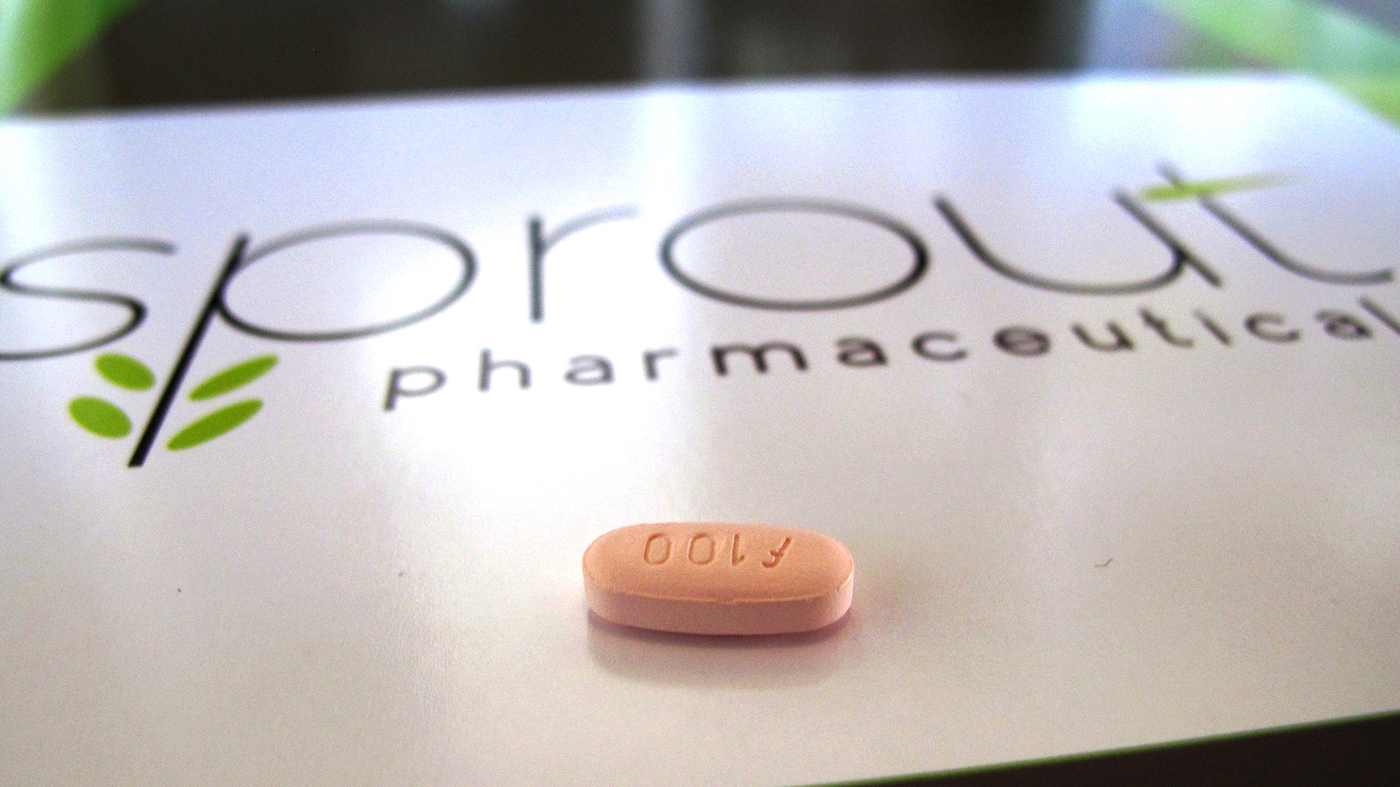
Sprout Pharmaceuticals’ Female Viagra Closer to Becoming Publicly Available

The experimental drug flibanserin, made by Sprout Pharmaceuticals, is at the center of a regulatory controversy.

The experimental drug flibanserin, made by Sprout Pharmaceuticals, is at the center of a regulatory controversy.

Sprout Pharmaceuticals has developed what they’re calling the Viagra for women. The new drug, named Flibanserin, purports to treat hypoactive sexual desire disorder (low sex drive, in other words) in pre-menopausal women. So far, $50M has been raised in preparation for the drug’s launch, and the Food & Drug Administration (FDA) has approved its benefits/risk profile.

The drug, now known as ADDYI, has had a long road thus far:  The drug was first rejected in 2010, when it was determined that the risks outweighed the dubious (at the time) benefits. Sprout began working on the drug in 2011, after being sold by the drug’s initial developer Boehringer Ingelheim. In December 2013, the FDA had rejected the drug for the second time.

In February 2014, the FDA wanted to see more tests done, specifically how the drug behaved when used with other medications. (Almost 10% of women taking the pill reported sleepiness during the trial.) The company resubmitted New Drug Application (NDA) this past February. The “little pink pill” was approved by an FDA advisory committee (done one step before final FDA approval), provided that more safety restrictions were added.

So far, Flibanserin/ADDYI has been tested on 11K+ women, and claims to be the “one of the most studied women’s health products in history.” Here’s what Sprout found after some recent trials:

In three 24-week randomized Phase 3, six-month, double-blind, placebo-controlled, parallel-group North American studies of premenopausal women with a mean age of 36 years, ADDYI consistently demonstrated a highly statistically significant difference over placebo on three key endpoints, including increase in sexual desire, decrease in distress from the loss of sexual desire and increase in the frequency of satisfying sex. Women treated with ADDYI showed significant improvements at every point of measurement in all pivotal clinical trials, with benefits seen as early as four weeks and sustained over the 24-week treatment period.

It’s too early to know when the drug will hit the public market. But it’ll be interesting to see how it performs (haha).

By The Numbers: How Many States Require an Ultrasound Viewing Before an Abortion?

WASHINGTON, DC - MARCH 16: Wisconsin Gov. Scott Walker speaks at the 2013 Conservative Political Action Conference (CPAC) March 16, 2013 in National Harbor, Maryland. The American Conservative Union held its annual conference in the suburb of Washington, DC to rally conservatives and generate ideas.  (Photo by Pete Marovich/Getty Images)

WASHINGTON, DC – MARCH 16: Wisconsin Gov. Scott Walker speaks at the 2013 Conservative Political Action Conference (CPAC) March 16, 2013 in National Harbor, Maryland. The American Conservative Union held its annual conference in the suburb of Washington, DC to rally conservatives and generate ideas. (Photo by Pete Marovich/Getty Images)

Earlier this week, Wisconsin Republican governor/maybe-presidential hopeful Scott Walker signed a new law requiring that women who wanted to get abortions be required to get an ultrasound of the fetus before making their decision. Walker’s reasoning was that he wanted women to make informed choices (i.e. choose life!) about their unborn children. (Side note: he also referred to ultrasounds as “a cool thing out there.” I’m not touching that one.)

I wanted to find out how widespread the practice of requiring expectant mothers to view an ultrasound before proceeding with an abortion was. So I turned to trusty source The Guttmacher Institute for some stats.

Number of states that require giving contextual information (i.e. written materials and/or verbal counseling) around the ultrasound: 12

Number of states that require the abortion provider to show and describe the ultrasound: 3

Number of states that require the abortion provider to offer a viewing of the ultrasound if it’s part of the abortion process: 9

The Guttmacher has more numbers on this topic. Personally, I find it fascinating that these laws are essentially banking on the assumed fact that women are ruled by their emotions and are baby-crazy, and so seeing an ultrasound before an abortion would change their minds.

How Has Colorado’s Teen Pregnancy Rate Dropped 40% Within 4 Years?

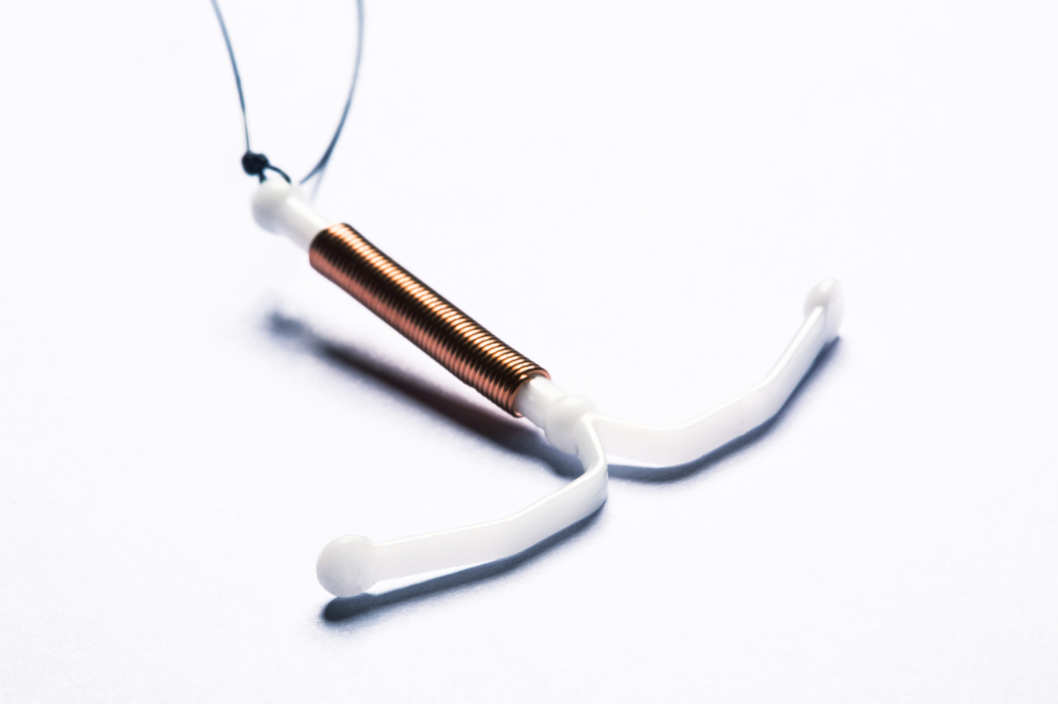
IUD (NY Mag)

IUD (NY Mag)

Colorado’s teen pregnancy rate has been getting some attention recently. But it’s not for the reason you think; it’s actually for the opposite reason.

From 2009 to 2013, Colorado reported a 40% decrease in teenage pregnancies, according to the Colorado Department of Public Health and Environment. Below is a graph that shows the decline:

Colorado's Birth Rate 2005-2012 (The Washington Post)

Colorado’s Birth Rate 2005-2012 (The Washington Post)

That seems insane, right? But there’s actually an interesting reason behind it.

In 2008, an anonymous donor (later revealed to be the Susan Thompson Buffett Foundation, named after Warren Buffett’s late wife) gave a $23 gift to be parceled out over five years. The gift was to be used for “long-term contraception” for low-income teens and women. Over 30K intrauterine devices (IUDs) were purchased and implemented. This measure was rolled out in 68 clinics, as part of Colorado’s Family Planning Initiative.

The IUDs were found to be a very significant factor in the state’s teen pregnancy decline. The study released by the Colorado Department of Public Health and Environment showed that “the percentage of young women receiving IUDs and implants quadrupled in participating clinics,” and, in a complementary effect, the women receiving IUDs accounted for 75% of the state’s overall teen birth rate decline.

On a national scale, Colorado rose from having the “29th lowest teen birth rate in the nation to the 19th.” This is significant as seven in 10 teen pregnancies in the state are unplanned.

The program expires this summer, and it’s unclear whether it will be renewed. But the numbers definitely speak for themselves in terms of effectiveness.


“Mother of Lamaze” Elisabeth Bing Has Died

Elisabeth Bing (The New York Times)

Elisabeth Bing (The New York Times)

Elisabeth Bing, credited for bringing Dr. Fernand Lamaze’s childbirth techniques to American women, has died at age 100 in New York.

The Lamaze method emphasized relaxation during childbirth, and posited that a mother’s pain during giving birth stemmed from fear. Having studied natural childbirth since 1942, Bing first encountered Lamaze’s technique in the 1950s. In 1960, she and a colleague founded Lamaze International, then known as the American Society for Psychoprophylaxis in Obstetrics.

It’s estimated that 25% of expectant mothers and spouses attend a Lamaze class at some point during pregnancy. For context, almost 4M babies were born in 2010. This would put the number of Lamaze-attending parents-to-be around 1M. (But this wouldn’t be completely accurate because it assumes that every mother only gave birth to one child.)

Bing’s goal was to help empower women to make their own decisions regarding how childbirth would go for them, and she certainly achieved that.