By The Numbers: How Many States Require an Ultrasound Viewing Before an Abortion?

WASHINGTON, DC - MARCH 16: Wisconsin Gov. Scott Walker speaks at the 2013 Conservative Political Action Conference (CPAC) March 16, 2013 in National Harbor, Maryland. The American Conservative Union held its annual conference in the suburb of Washington, DC to rally conservatives and generate ideas.  (Photo by Pete Marovich/Getty Images)

WASHINGTON, DC – MARCH 16: Wisconsin Gov. Scott Walker speaks at the 2013 Conservative Political Action Conference (CPAC) March 16, 2013 in National Harbor, Maryland. The American Conservative Union held its annual conference in the suburb of Washington, DC to rally conservatives and generate ideas. (Photo by Pete Marovich/Getty Images)

Earlier this week, Wisconsin Republican governor/maybe-presidential hopeful Scott Walker signed a new law requiring that women who wanted to get abortions be required to get an ultrasound of the fetus before making their decision. Walker’s reasoning was that he wanted women to make informed choices (i.e. choose life!) about their unborn children. (Side note: he also referred to ultrasounds as “a cool thing out there.” I’m not touching that one.)

I wanted to find out how widespread the practice of requiring expectant mothers to view an ultrasound before proceeding with an abortion was. So I turned to trusty source The Guttmacher Institute for some stats.

Number of states that require giving contextual information (i.e. written materials and/or verbal counseling) around the ultrasound: 12

Number of states that require the abortion provider to show and describe the ultrasound: 3

Number of states that require the abortion provider to offer a viewing of the ultrasound if it’s part of the abortion process: 9

The Guttmacher has more numbers on this topic. Personally, I find it fascinating that these laws are essentially banking on the assumed fact that women are ruled by their emotions and are baby-crazy, and so seeing an ultrasound before an abortion would change their minds.
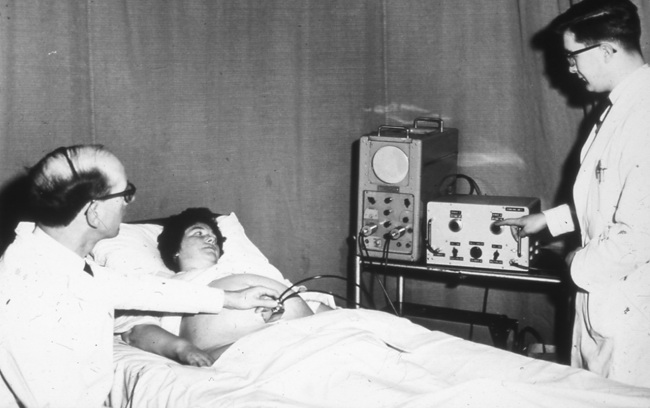

#ThrowbackThursday: Ultrasound, 1963

Ultrasound, 1963 (University of Cambridge)

Ultrasound, 1963 (University of Cambridge)

The first obstetric ultrasound was developed in 1956 in Scotland by Ian Donald and Tom Brown, using a prototype based off detecting flaws in industrial ships. It began to be used regularly within the country, and later spread to the U.K. and America in the 1970s.


Ultrasounds use ultrasonic waves to determine features of the fetus. Early on, this couldn’t be done, as the technology wasn’t nearly as advanced. It’s fascinating to see how it’s caught up.

How Has Colorado’s Teen Pregnancy Rate Dropped 40% Within 4 Years?

IUD (NY Mag)

IUD (NY Mag)

Colorado’s teen pregnancy rate has been getting some attention recently. But it’s not for the reason you think; it’s actually for the opposite reason.

From 2009 to 2013, Colorado reported a 40% decrease in teenage pregnancies, according to the Colorado Department of Public Health and Environment. Below is a graph that shows the decline:

Colorado's Birth Rate 2005-2012 (The Washington Post)

Colorado’s Birth Rate 2005-2012 (The Washington Post)

That seems insane, right? But there’s actually an interesting reason behind it.

In 2008, an anonymous donor (later revealed to be the Susan Thompson Buffett Foundation, named after Warren Buffett’s late wife) gave a $23 gift to be parceled out over five years. The gift was to be used for “long-term contraception” for low-income teens and women. Over 30K intrauterine devices (IUDs) were purchased and implemented. This measure was rolled out in 68 clinics, as part of Colorado’s Family Planning Initiative.

The IUDs were found to be a very significant factor in the state’s teen pregnancy decline. The study released by the Colorado Department of Public Health and Environment showed that “the percentage of young women receiving IUDs and implants quadrupled in participating clinics,” and, in a complementary effect, the women receiving IUDs accounted for 75% of the state’s overall teen birth rate decline.

On a national scale, Colorado rose from having the “29th lowest teen birth rate in the nation to the 19th.” This is significant as seven in 10 teen pregnancies in the state are unplanned.

The program expires this summer, and it’s unclear whether it will be renewed. But the numbers definitely speak for themselves in terms of effectiveness.


Pregnant Girls Banned from Sierra Leone Schools

Pregnant Sierra Leone woman (The Fatou Blog)

Pregnant Sierra Leone woman (The Fatou Blog)

Schools in Sierra Leone closed during the Ebola epidemic are scheduled to re-open today, welcoming children eager to learn again. But the country’s Minister of Education Minkailu Bah has banned one group from returning: pregnant teen girls, claiming they’re a distraction to their peers and would hinder learning.

Incidentally, this ban isn’t new, having been in place since 2010. But it’s making headlines now.

Whether or not this qualifies as a “distraction” is another debate entirely, but teenage pregnancies within the country are becoming more common. A recent long-term study by the UNESCO HIV and Health Education Clearing House found that 33%+ of all Sierran Leonian pregnancies involve teen girls, and nearly 40%+ are involved in a “maternal death.” For context relative to the size of the country’s population, 41% of Sierra Leone citizens are under age 18. Those are some scary stats.

Sierra Leone isn’t the only country battling this issue. As a whole, Africa has the highest rates of teenage pregnancies, taking 18 of the top 20 spots in a 2013 United Nations Population Fund (UNFPA) rankings report.

The recent teenage pregnancy epidemic has been attributed to Ebola, in that girls who might otherwise be attending school are now more vulnerable to sexual violence. They may also have to survive and provide, and do so via prostitution. So there might be a bit of a substitution effect at play here.

But human rights governing bodies have taken note of Bah’s stance. The United Nations issued a statement in which stated that “education is a fundamental human right that Sierra Leone has committed itself to uphold.” The UN also reminded the country of its own Education Act, passed in 2004, which barred discrimination of those seeking education.

We’ll see how Bah’s proposed idea pans out. But the words of UNFPA’s Executive Director Babatunde Osotimehin ring true here:

Adolescent pregnancy is intertwined with issues of human rights. A pregnant girl who is pressured or forced to leave school, for example, is denied her right to education.

Dr. Carl Djerassi, Father of The Pill, Has Died

Dr. Carl Djerassi (Rutgers News)

Dr. Carl Djerassi (Rutgers News)

Modern contraception pioneer Dr. Carl Djerassi died last Friday in San Francisco. He was 91 years old, and had suffered from complications of liver and bone cancer.

Often called the father of The Pill, Djerassi found an essential component of the now-common family planning product. In 1951, while working as a researcher at Syntex in Mexico City, he and two others successfully synthesized norethindrone, a progestin that later provided the base of the modern birth control pill. Djerassi and his team received a patent for their discovery.

Initially, the scientists thought that norethindrone would help fertility, but they soon realized that it served another purpose. The team knew that progesterone inhibited ovulation during pregnancy. They modified the progestin’s basic structure and added ethisterone, a compound thought to be devoid of medical value. (Warning: science-speak ahead.)

Djerassi’s team found that they could change the structure of progesterone to increase its potency eightfold. This progesterone analogue was strong enough to work when injected, but lost its potency when administered orally…Djerassi’s group made the same chemical modification in ethisterone that they had earlier made in progesterone.

(Interesting side note: At the time, Djerassi wasn’t researching anything to do with conception when he and his team made his famous discovery. He was actually looking for a compound that could be used to treat cancer. Happy accident, as they say.)

After five years of clinical trials, the birth control pill began reached the mass market, and cracked 1960s sexual norms wide open. (And we’re still feeling the effects of it today.)

This wasn’t his only big discovery: Djerassi also patented the first antihistamine, the drug that prevents allergy symptoms.

During his lifetime, Djerassi received 34 honorary doctorates. He was also the recipient of the National Medal of Science for chemistry in 1973, and the National Medal of Technology and Innovation in 1991. The two awards are the U.S.’s highest science and technology honors, respectively.

In addition to his scientific accomplishments, Djerassi also wrote plays (some performed off-Broadway) and science-fiction, founded a company to control insect growth, and started an artists’ colony in his property in California.

Dr. Djerassi’s contributions to family planning were, and continue to be, a boon to women the world over, and his work will continue to hold great value for the coming generations.

Thank you, Dr. Djerassi. Thank you.


The U.S. Abortion Rate Has Been Decreasing Since 2002

Baby (Santa Banta)

Baby (Santa Banta)

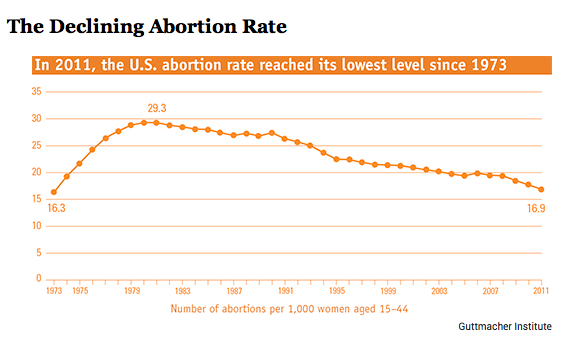
Abortion rates have been falling over the years. The Centers for Disease Control and Prevention (CDC) completed a study last year that analyzed long-term abortion trends, spanning from 1969 to 2011.

The Declining Abortion Rate (The Atlantic)

The Declining Abortion Rate (The Atlantic)

The CDC counted 730K+ abortions in 2011, which works out to 16.9 abortions per 1K women ages 15-44. This is the lowest ratio for abortions since 1973, where 16.3 abortions were recorded for every 1K women within the aforementioned age range. The study’s abstract notes that abortions were highest among adolescents and lowest among women ages 30-39 for the duration of the study. Women in their 20s had the majority of abortions.

Researchers speculate that the decrease in abortions is linked to changing social attitudes about the practice, as well as marriage. When marriage was the socially-acceptable default setting for relationships, abortions were much more rare. But now that marriage rates have decreased, many women are choosing to terminate an unplanned pregnancy rather than have a shotgun wedding with the father.

An article on “The Atlantic” also notes that American attitudes toward abortion have shifted in recent years. While only 20% of the surveyed population would like to see the practice outlawed, 38% surveyed believe it’s “morally objectionable.” This prevailing idea is likely preventing some women from having abortions, and so carrying the fetus the term. It’s very possible that the numbers on abortion are higher than reported, due to any lingering shame or stigma (either internal or external) women who’ve gone through it may face.


Will In Vitro Fertilization (IVF) Replace Sex?

Couple in bed

Couple in bed

Dr. Carl Djerassi recently predicted that sex would become purely recreational by 2050 since so many women are having children via in vitro fertilization (IVF). But do the numbers bear this out?

Earlier this year, the Society for Assisted Reproductive Technology released a report examining success rates from many IVF clinics. The report revealed that in 2012, IVF clinics performed 165K+ procedures, out of which 61K+ babies were born. Therefore the year had a 37%+ success rate. Two thousand more babies were born in 2012 than in the previous year, and 2012 also had the highest percentage of babies born through IVF thus far.

Dr. Djerassi also remarked that advances in IVF technology will allow parents without fertility problems to consider the procedure. This would, in turn, free up the potential parents (and everyone else) for consequence-free sex.

And Dr. Djerassi would know about recreational sex: In 1951, he helped invent The Pill.