Ohio Bans Abortions After 20 Weeks

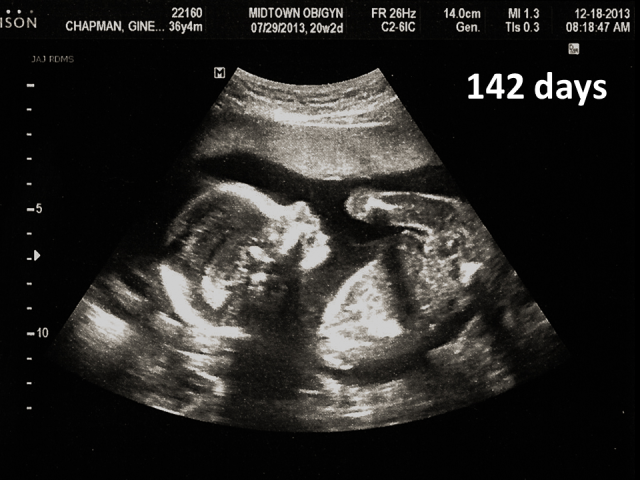
Ultrasound of fetus at 20 weeks (The Times in Plain English)

Ultrasound of fetus at 20 weeks (The Times in Plain English)

Another blow for women’s health: Ohio Governor John Kasich (yes, the former Republican presidential hopeful) signed a bill to approve banning abortions after the 20th week of pregnancy. (To put this in context, most pregnancies are around 40 weeks long.)

The Senate Bill 127, signed December 2016, does not allow for exceptions in rape and incest cases. Supporters of the bill claim that the fetus can feel pain at 20 weeks. (I’m curious how they know this; did they ask the fetus through the ultrasound?) The only exception will be for women whose pregnancy puts their health at risk.

Providers caught performing abortions after 20 weeks will charged with a “fourth-degree felony.”

Earlier that month, Kasich tried to sign a “heartbeat” bill, which would ban abortion after six weeks. A heartbeat pulse can generally be found around that time, though women may not know they’re pregnant. He eventually vetoed it due to overwhelming public pressure.

Around 1% of abortions occur after 20 weeks. The new law takes effect Mar. 14, 2017.

Poland Votes Against Abortion Ban

Polish protest against proposed abortion ban (Religion News)

People demonstrate against the Polish government’s plan to tightening the abortion law in Krakow, Poland April 3, 2016. The signs read: “I’m giving birth from love not from being forced” and “My womb does not belong to homeland” (R). REUTERS/Lukasz Kaminski/Agencja Gazeta

Last week, Poland voted against a proposal to completely ban abortion.

This is significant because Poland has stringent rules as to when abortions could be used: only in “cases of rape, incest, a threat to the life of the mother or irreparable damage to the fetus.” Poland has one of the strongest policies against abortion in Europe. Right now, that rule still stands, though the total abortion ban has not moved forward with the country’s Law and Justice ruling party.

The proposed ban would’ve carried a five-year prison sentence both for women undergoing the abortion and their doctors who assisted.

The day before the ruling, Polish women turned out in enormous numbers to protest the proposed ban. It’s estimated that Warsaw, the Polish capital, saw around 30K+ women protesting. There were also protests around the country, with many women not going to work and many offices had to shut down for the day.

The proposed abortion ban came from a petition signed by 450K+ people. This represents 1.2% of Poland’s 38M+ residents.

A recent poll, taken before the protest and subsequent ruling, found that 74% of Polish residents don’t want the current abortion laws to change.

Which U.S State Has the Highest Maternal Mortality Rate?

Pregnant woman (SLO County)

Pregnant woman (SLO County)

You wouldn’t necessarily guess that *any* state in the U.S. has a high maternal mortality rate (i.e. mothers who die due to pregnancy- and birth-related complications), but one has that dubious honor. And that is the great state of Texas.

In the September issue of medical journal Obstretics and Gynecology, a report found the following:

The maternal mortality rate in the United States increased between 2000 and 2014, even while the rest of the world succeeded in reducing its rate. Excluding California, where maternal mortality declined, and Texas, where it surged, the estimated number of maternal deaths per 100,000 births rose to 23.8 in 2014 from 18.8 in 2000 – or about 27%.

Bet you didn’t expect that, right? (I certainly didn’t.) But how bad is it really?

From 2000 to the end of 2010, Texas’s estimated maternal mortality rate hovered between 17.7 and 18.6 per 100,000 births. But after 2010, that rate had leaped to 33 deaths per 100,000, and in 2014 it was 35.8. Between 2010 and 2014, more than 600 women died for reasons related to their pregnancies.

Texas is part of the developed world, so the maternal mortality rate surge cannot be explained by “war, natural disaster, or severe economic upheaval.” So what is it?

In recent years, Texas has severely decreased women’s access to spaces that offer medical services for reproductive health. In 2011, “the Texas state legislature cut $73.6M from the state’s family planning budget of $111.5M.” This measure resulted in 80 clinics closing across the state. Planned Parenthood clinics were also completely eliminated, which cut off access to reproductive health measures for lower-income women especially. Planned Parenthood had previously served 130K+ women across the state.

While Texas restored the family planning budget to its original level in 2013, the damage was already done: Many clinics are still struggling to provide the same level of care and service they provided before the cut. But Texas clinics are now offering free IUDs, so there’s some hope they’ll be flourishing soon.


The Teen Birth Rate Is Declining

Teenage girls with pregnancy test (Young Adults)

Teenage girls with pregnancy test (Young Adults)

When I was growing up in the ’90s, teenage pregnancy was just a fact. It was depicted in movies and on TV, and you probably knew at least one girl in your school who got pregnant.

But teenage pregnancy now seems so…dated. Times have changed. Having kids young and outside of wedlock isn’t a big deal anymore. And I feel like I’m not seeing teen pregnancies focused on so much anymore (granted, that might be because I’m no longer a teen myself).

There’s a good reason for this: the teen birth rate is decreasing.

According to the U.S Department of Health & Human Services’ Office of Adolescent Health, the teenage birth rate in the U.S. has actually been decreasing for over 20 years. In 1991, there were 61.8 babies born for every 1k teenage girls. In 2014, there were 24.2 babies born for every 1K teenage girls. Quite a drop.

Even the year-over-year drops can be steep. The 2014 number is a 9% drop from 2013, where 26.5 babies were born to every 1K teenage girls. And the 2015 number of 22 babies per every 1K teenage girls is a 8% decrease from 2014.

For a longer-term view of how the teen birth rate has declined from the previous decade, CNN has the scoop:

Since 2007, the year-to-year decline in teen birth rates has been between 7% and 9%…The number of teens becoming moms has dropped by a total of 54% from 2007 to 2015.

That’s huge! We’ll see how small the number of teenage pregnancies eventually gets.


Link Between Tonsils and Appendix and Fertility Discovered

Tonsils (Daily Mail UK)

Today in “Things You (Probably) Wouldn’t Guess:” Scientists have discovered that the presence of tonsils or an appendix affects fertility.

A study conducted by University of Dundee and University College London found that if woman had either organ removed, they were more likely to both to become pregnant, but also to get pregnant earlier in life. (If you remember from middle school math class, this is what’s called an inverse relationship.) The study followed 530K+ women in the UK over a 15-year period. Over 54K women had their appendix removed, 112K+ women had their tonsils removed, and 10K+ women had both appendices and tonsils removed.

Women who’d had their appendix removed got pregnant at a 34% higher rate than women who still had their appendix. Women who’d had their tonsils removed got pregnant at a 49% (!) higher rate than women who still had their tonsils. And women who’d had both procedures got pregnant at a 43% higher rate than women who had not undergone both procedures.

It’s not clear yet why these things are linked together. But it flies in the face of long-time conventional medical wisdom, which had previously declared that removing a woman’s appendix affected her future fertility due to scarring around her fallopian tubes (a crucial passage for her eggs).


The Pentagon Will Pay to Freeze Troops’ Sperm and Eggs

Military troops (The Political Insider)

Military troops (The Political Insider)

Family-friendly policies have been proliferating workplace culture within the past year, and now there’s another company to add to that list: the Pentagon.

The Defense Department will a pilot program that allows troops to freeze sperm and eggs in an effort to retain service members. This policy is especially aimed at women: After 10 years of service (which would place a woman in her late 20s, assuming she enlisted when she was 18), women’s retention rate is 30% less than that of men’s. The cost is estimated to be around $150M for five years, or  $30M per year.

The move comes as the Defense Department noted changing policies that allowed for longer maternity leaves and “improved child care.” After creating a plan, the Defense Department will outline a plan, and will evaluate two years after implementation. The Defense Department is following in the footsteps of certain Silicon Valley companies such as Facebook, which recently began offering female employees the option of freezing their eggs.

So far, the Defense Department is the only government agency that will allow freezing sperm and eggs within their healthcare policy.

It’ll be interesting to see how the pilot program goes, and how it changes the quality of life for military members.

El Salvadorian Government Advises Women Not Get Pregnant Due to Zika Virus

Baby with microcephaly (Health Then More)

Baby with microcephaly (Health Then More)

Despite arriving on the viral diseases scene just recently, the Zika virus has already made a large impact. The first cases in the Americas were reported in Brazil last spring, where the virus was linked to birth defects that affected brain development. The most commonly cited birth defect was microcephaly, which results in an abnormally small brain. Earlier this year, the Centers for Disease Control and Prevention (CDC) here in the U.S. have advised that pregnant women should not travel to the 14 countries affected by the virus.

Now, the government of El Salvador (one of the affected countries) is going one step further and advising women of childbearing age to refrain from getting pregnant until 2018. The announcement came after 5K+ cases of the virus were detected in women in 2015 and early this year. Of this number, it’s suspected that 96 women had contracted the virus, but so far, none have resulted in microcephaly. I couldn’t find information on how high-risk El Salvador is for the Zika virus, but this measure would lead me to believe that it looks pretty dire.

The government of Colombia has released a similar warning, but is advising women to wait six to eight months. Colombia has the second-highest rate of Zika infections after Brazil.

In terms of each country’s birth rates (counted as births per 1K people), El Salvador has 16.79. It just edges past Colombia with a birth rate of 16.73. By contrast, Brazil has a birth rate of 14.72. It’ll be interesting to see how El Salvador and Colombia’s birth rates are affected this year by their respective government’s measures.

The Zika virus is transmitted via mosquito, and is characterized by joint pain, fever, rash and red eyes.


Trends: Opening Up About Miscarriages

Mark Zuckerberg and Priscilla Chan, 2015 (Business Insider)

Mark Zuckerberg and Priscilla Chan Zuckerberg (Business Insider)

When Facebook founder Mark Zuckerberg announced that his wife was pregnant with their first child last summer, he made another important statement: that his wife Priscilla had endured three miscarriages over the course of three years.

It’s a huge thing to acknowledge, especially since it seems that any narrative other than an easy pregnancy is given short shift. I applaud Zuckerberg for speaking up about what he and his wife went through, and what many more people work through.

But he hasn’t been the only one. Lately, many celebrities/people with social influence have been speaking up about that painful time in their lives.

Actress Eva Amurri Martino experienced a miscarriage as well, and spoke about it publicly two weeks after Zuckererg’s announcement. Martino’s miscarriage occurred around nine weeks after conception. Earlier this year, actress Kimberly McCullough revealed that she’d suffered a miscarriage last year, losing her baby at 22 weeks.

Shining a light on something helps to normalize it, and hopefully these confessions will encourage others to open up about their personal experiences. We need to keep talking about miscarriages to destigmatize them.

#ThrowbackThursday: Mark Zuckerberg and Pregnant Priscilla Chan, 2015

Mark Zuckerberg and Priscilla Chan, 2015 (Business Insider)

Mark Zuckerberg and Priscilla Chan Zuckerberg (Business Insider)

On July 31, 2015, Facebook founder Mark Zuckerberg announced on (where else?) Facebook that he and his wife Priscilla were expecting a baby girl. He also revealed that the couple had weathered three miscarriages in the span of two years.

Zuckerberg rarely posts personal things on his own site, so this was a break from routine for him. The confession earned him praise.

The Zuckerbergs’ daughter Max was born on Dec. 1, 2015.

Zika Virus Linked to Birth Defects

Mosquito (NPR)

Mosquito (NPR)

Earlier this month, the Centers for Disease Prevention and Control (CDC) released a travel warning for pregnant women. They’ve issued the warning for 14 countries where the Zika virus has been confirmed to be transmitted.

Transmitted through bites of infected mosquitos, the Zika virus symptoms include fever, rashes and red eyes. It’s also been linked to birth defects.

Brazil was the first country to report birth defects linked to Zika. Specifically, the virus manifests as microcephaly, where newborns will have an unusually small head that leads to abnormal brain development. Over 2.4K cases of newborns affected by Zika were recorded in 2015, up from only 147 cases in 2014. This was a 1,532%+ year-over-year increase.

And the U.S. is no longer exempt from Zika’s reach: A baby with microcephaly was confirmed to have the virus. The baby was born in Hawaii last week.