By The Numbers: How Many States Require an Ultrasound Viewing Before an Abortion?

WASHINGTON, DC - MARCH 16: Wisconsin Gov. Scott Walker speaks at the 2013 Conservative Political Action Conference (CPAC) March 16, 2013 in National Harbor, Maryland. The American Conservative Union held its annual conference in the suburb of Washington, DC to rally conservatives and generate ideas.  (Photo by Pete Marovich/Getty Images)

WASHINGTON, DC – MARCH 16: Wisconsin Gov. Scott Walker speaks at the 2013 Conservative Political Action Conference (CPAC) March 16, 2013 in National Harbor, Maryland. The American Conservative Union held its annual conference in the suburb of Washington, DC to rally conservatives and generate ideas. (Photo by Pete Marovich/Getty Images)

Earlier this week, Wisconsin Republican governor/maybe-presidential hopeful Scott Walker signed a new law requiring that women who wanted to get abortions be required to get an ultrasound of the fetus before making their decision. Walker’s reasoning was that he wanted women to make informed choices (i.e. choose life!) about their unborn children. (Side note: he also referred to ultrasounds as “a cool thing out there.” I’m not touching that one.)

I wanted to find out how widespread the practice of requiring expectant mothers to view an ultrasound before proceeding with an abortion was. So I turned to trusty source The Guttmacher Institute for some stats.

Number of states that require giving contextual information (i.e. written materials and/or verbal counseling) around the ultrasound: 12

Number of states that require the abortion provider to show and describe the ultrasound: 3

Number of states that require the abortion provider to offer a viewing of the ultrasound if it’s part of the abortion process: 9

The Guttmacher has more numbers on this topic. Personally, I find it fascinating that these laws are essentially banking on the assumed fact that women are ruled by their emotions and are baby-crazy, and so seeing an ultrasound before an abortion would change their minds.


Colleges and Universities with Graduate-Level Sexuality Programs: By The Numbers

The Kinsey Institute (Wikipedia)

The Kinsey Institute (Wikipedia)

For those who are thinking (or planning on) making a career in the study of sexuality and would like to go the academic route, there are some schools which offer programs geared towards the subject. Several schools have undergrad courses and certifications, but there are also some graduate programs in which one can get a master’s or a Ph.D. degree.

This is by no means a comprehensive list, but a general smattering of the options out there.

Number in California: 2

San Francisco State University:

Program: Sexuality Studies

California Institute of Integral Studies (CIIS):

Program: Human Sexuality

– Concentrations: Clinical Psychology or Sexual Policy Leadership


Number in Indiana: 1

Indiana University Bloomington:

ProgramThe Kinsey Institute for Research in Sex, Gender, and Reproduction


Number in Hawaii: 1

University of Hawaii at Manoa

Program: Pacific Center for Sex and Society


As I mentioned, there are several programs out there, but these should be enough to pique your interest!

#ThrowbackThursday: Dr. Alfred Kinsey Lecturing at UC Berkeley, 1949

Dr. Alfred Kinsey lecturing at UC Berkeley, 1949 (The Guardian)

Dr. Alfred Kinsey lecturing at UC Berkeley, 1949 (The Guardian)

Dr. Alfred Kinsey, known to be one of the (if not the) father of modern sexology, lectured to a packed house at the University of California, Berkeley in 1949. This lecture capped off a big decade for him: He began by teaching a class on marriage (attended mostly by women) in which he espoused his beliefs on sexual frankness and equality for both genders. In 1947, he founded the Institute for Sex Research (now called The Kinsey Institute) at Indiana University. The following year, he wrote the breakthrough work “Sexual Behavior in the Human Male.”

I couldn’t find any further information on this image. But look how many people are there to hear him speak! I’m sure it helped that his book had sold 200K+ within the first two months of its release. He was truly a rockstar, and I wonder what it would’ve been like to hear him speak.

Why is There an Orgasm Gap in Hook-Ups vs. Relationships?

Orgasm (NYC Barstool Sports)

Orgasm (NYC Barstool Sports)

In honor of International Women’s Day yesterday, let’s examine a very real issue that a lot of women face: the orgasm gap in hookups vs. relationships.

There have been a few studies on this. A 2013 study by the Kinsey Institute at Indiana University found that “women were twice as likely to reach orgasm from intercourse or oral sex in serious relationships as in hookups.” The study surveyed 600 male and female college students. A study out of New York University found that only 40% of women achieved orgasm during their most recent hookup that included sex, where 80% of men reported climaxing. This study polled 24K students at 21 colleges.

But when a woman is in a committed relationship, their orgasm rate shoots up to 75%.

Why is this?

There are several reasons for this: more frequent and consistent practice with a steady partner, communication with a partner and/or feeling empowered and confident within one’s sexuality.

Dr. Debby Herbenick of The Kinsey Institute points out that men tend to report orgasms more than women, so the number of women having orgasms might well be higher. Also, the term “hook(ing) up” includes sexual acts that might not result in having an orgasm, such as kissing.

But women can have sex and get pregnant without climaxing. So why are we so worried about having one (or multiples)?

Dr. Elisabeth A. Lloyd, author of “The Case of the Female Orgasm: Bias in the Science of Evolution,” puts it best:

“The female orgasm is for fun.”

And she’s so totally right. So get out there and go get yours!

“Fifty Shades of Grey:” What the Hell is BDSM, Anyway?

'Fifty Shades of Grey' still (MoviePilot)

‘Fifty Shades of Grey’ still (MoviePilot)

This week, we’re examining different aspects of “Fifty Shades of Grey,” in preparation for the upcoming movie, opening on Feb. 13th. 

“Fifty Shades of Grey” depicts BDSM as pretty hardcore: There are whips, chains and cable ties all in Christian Grey’s Red Room of Pain. A person (let’s be honest, woman) reading the book with no prior knowledge and/or experience of BDSM would likely be inclined to believe that’s primarily what the consensual sex practice about.

But BDSM isn’t just about the hardcore stuff. It encompasses a wide variety of activities. The four letters can be arranged to refer to different practices under the BDSM umbrella: B&D (bondage & discipline), S&M (sadomasochism), D&S (dominance & submission).

Dr. Richard A. Sprott, executive director of the Community-Academic Consortium for Research on Alternative Sexualities (CARAS), notes that BDSM can be synonymous with “kink, fetish, leather, and S&M.” The term can denote “a practice, lifestyle or orientation.”

Sprott labels the two most important components as “consensuality and mutually defined activities.” Other common aspects include “eroticization of power, role-playing/fantasy, and intense sensory stimulation and/or physical restriction.” Roles include the dominant, submissive and switch (someone who plays both dom and sub roles as needed). A BDSM “scene” (single session of play) has three parts: negotiation (deciding what will happen), play (the scene itself) and aftercare (coming down from the scene).

The Teramis website concedes that “no acronym is ideal in defining” the term, and open communication must be used to find out a person’s specific kink. The most important rules are that things are kept “safe, sane and consensual.”

How widespread is it? The 1990 Kinsey Institute New Report on Sex found the following:

Researchers estimate that 5-10 percent of the U.S. population engages in sadomasochism for sexual pleasure on at least an occasional basis, with most incidents being either mild or stage activities involving no real pain or violence.

As “Fifty Shades of Grey” makes clear, audiences will react to the most extreme version of BDSM. But there are a lot of, dare I say, shades of grey within the moniker for practitioners.

The U.S. Abortion Rate Has Been Decreasing Since 2002

Baby (Santa Banta)

Baby (Santa Banta)

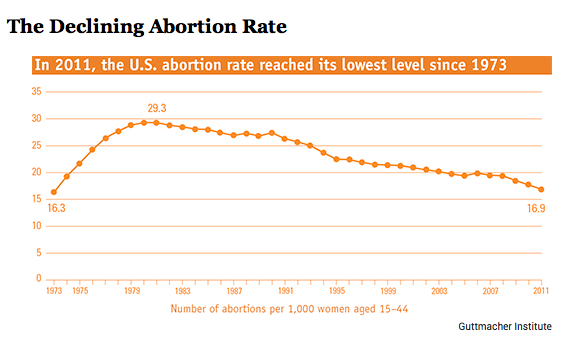
Abortion rates have been falling over the years. The Centers for Disease Control and Prevention (CDC) completed a study last year that analyzed long-term abortion trends, spanning from 1969 to 2011.

The Declining Abortion Rate (The Atlantic)

The Declining Abortion Rate (The Atlantic)

The CDC counted 730K+ abortions in 2011, which works out to 16.9 abortions per 1K women ages 15-44. This is the lowest ratio for abortions since 1973, where 16.3 abortions were recorded for every 1K women within the aforementioned age range. The study’s abstract notes that abortions were highest among adolescents and lowest among women ages 30-39 for the duration of the study. Women in their 20s had the majority of abortions.

Researchers speculate that the decrease in abortions is linked to changing social attitudes about the practice, as well as marriage. When marriage was the socially-acceptable default setting for relationships, abortions were much more rare. But now that marriage rates have decreased, many women are choosing to terminate an unplanned pregnancy rather than have a shotgun wedding with the father.

An article on “The Atlantic” also notes that American attitudes toward abortion have shifted in recent years. While only 20% of the surveyed population would like to see the practice outlawed, 38% surveyed believe it’s “morally objectionable.” This prevailing idea is likely preventing some women from having abortions, and so carrying the fetus the term. It’s very possible that the numbers on abortion are higher than reported, due to any lingering shame or stigma (either internal or external) women who’ve gone through it may face.