How Has Colorado’s Teen Pregnancy Rate Dropped 40% Within 4 Years?

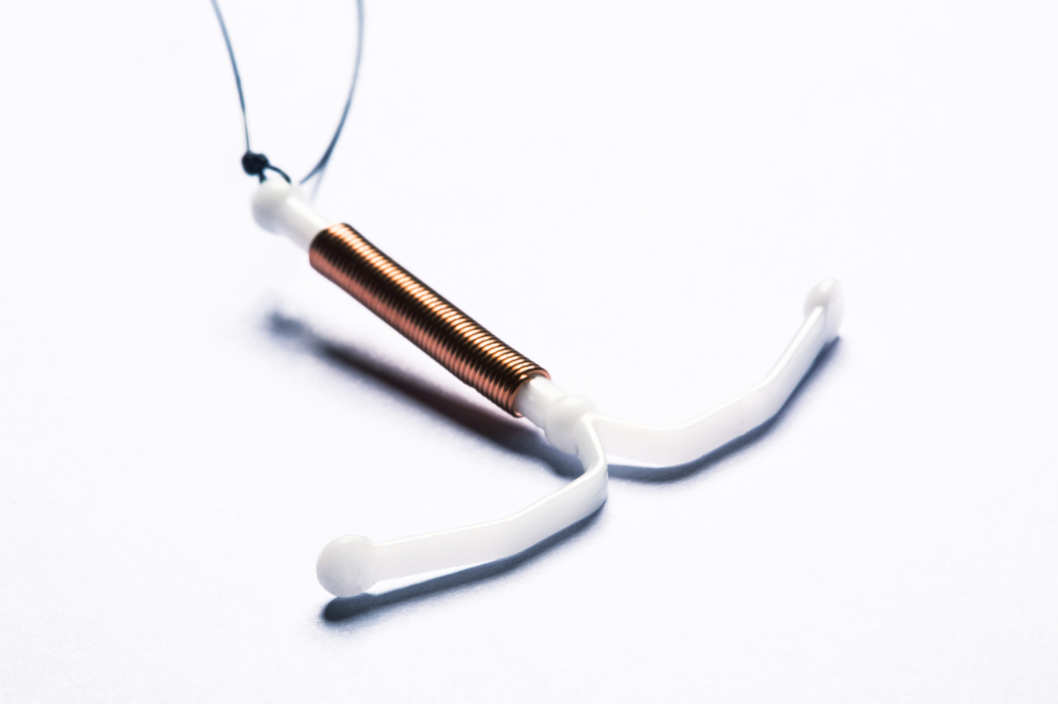
IUD (NY Mag)

IUD (NY Mag)

Colorado’s teen pregnancy rate has been getting some attention recently. But it’s not for the reason you think; it’s actually for the opposite reason.

From 2009 to 2013, Colorado reported a 40% decrease in teenage pregnancies, according to the Colorado Department of Public Health and Environment. Below is a graph that shows the decline:

Colorado's Birth Rate 2005-2012 (The Washington Post)

Colorado’s Birth Rate 2005-2012 (The Washington Post)

That seems insane, right? But there’s actually an interesting reason behind it.

In 2008, an anonymous donor (later revealed to be the Susan Thompson Buffett Foundation, named after Warren Buffett’s late wife) gave a $23 gift to be parceled out over five years. The gift was to be used for “long-term contraception” for low-income teens and women. Over 30K intrauterine devices (IUDs) were purchased and implemented. This measure was rolled out in 68 clinics, as part of Colorado’s Family Planning Initiative.

The IUDs were found to be a very significant factor in the state’s teen pregnancy decline. The study released by the Colorado Department of Public Health and Environment showed that “the percentage of young women receiving IUDs and implants quadrupled in participating clinics,” and, in a complementary effect, the women receiving IUDs accounted for 75% of the state’s overall teen birth rate decline.

On a national scale, Colorado rose from having the “29th lowest teen birth rate in the nation to the 19th.” This is significant as seven in 10 teen pregnancies in the state are unplanned.

The program expires this summer, and it’s unclear whether it will be renewed. But the numbers definitely speak for themselves in terms of effectiveness.



Dr. Carl Djerassi, Father of The Pill, Has Died

Dr. Carl Djerassi (Rutgers News)

Dr. Carl Djerassi (Rutgers News)

Modern contraception pioneer Dr. Carl Djerassi died last Friday in San Francisco. He was 91 years old, and had suffered from complications of liver and bone cancer.

Often called the father of The Pill, Djerassi found an essential component of the now-common family planning product. In 1951, while working as a researcher at Syntex in Mexico City, he and two others successfully synthesized norethindrone, a progestin that later provided the base of the modern birth control pill. Djerassi and his team received a patent for their discovery.

Initially, the scientists thought that norethindrone would help fertility, but they soon realized that it served another purpose. The team knew that progesterone inhibited ovulation during pregnancy. They modified the progestin’s basic structure and added ethisterone, a compound thought to be devoid of medical value. (Warning: science-speak ahead.)

Djerassi’s team found that they could change the structure of progesterone to increase its potency eightfold. This progesterone analogue was strong enough to work when injected, but lost its potency when administered orally…Djerassi’s group made the same chemical modification in ethisterone that they had earlier made in progesterone.

(Interesting side note: At the time, Djerassi wasn’t researching anything to do with conception when he and his team made his famous discovery. He was actually looking for a compound that could be used to treat cancer. Happy accident, as they say.)

After five years of clinical trials, the birth control pill began reached the mass market, and cracked 1960s sexual norms wide open. (And we’re still feeling the effects of it today.)

This wasn’t his only big discovery: Djerassi also patented the first antihistamine, the drug that prevents allergy symptoms.

During his lifetime, Djerassi received 34 honorary doctorates. He was also the recipient of the National Medal of Science for chemistry in 1973, and the National Medal of Technology and Innovation in 1991. The two awards are the U.S.’s highest science and technology honors, respectively.

In addition to his scientific accomplishments, Djerassi also wrote plays (some performed off-Broadway) and science-fiction, founded a company to control insect growth, and started an artists’ colony in his property in California.

Dr. Djerassi’s contributions to family planning were, and continue to be, a boon to women the world over, and his work will continue to hold great value for the coming generations.

Thank you, Dr. Djerassi. Thank you.


#ThrowbackThursday: Margaret Sanger’s Birth Control Clinical Research Bureau, 1923

Margaret Sanger's Birth Control Clinical Research Bureau (BCCRB) (The Margaret Sanger Papers Project)

Margaret Sanger’s Birth Control Clinical Research Bureau (BCCRB) (The Margaret Sanger Papers Project)

I found this photo on The Margaret Sanger Papers Project. One post notes that Sanger founded America’s first legal birth control clinic on Jan. 2, 1923. By the 1930s, the Birth Control Clinical Research Bureau (BCCRB) served 10K+ patients per year, and “trained thousands of doctors and nurses.”

In the undated photo above, a nurse teaches other women…I assume birth control and/or family planning. I can’t say definitely if they were doctors, nurses or patients, but I’m confident they received the most accurate information of the day.

#ThrowbackThursday: Dhanvanthi Rama Rau

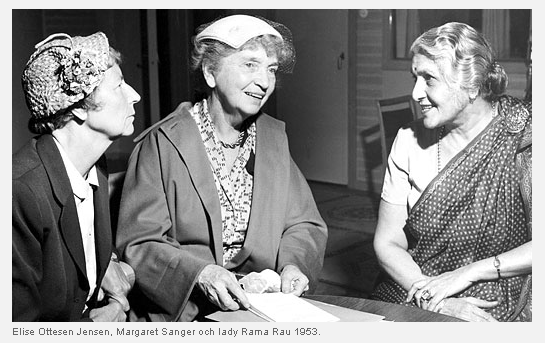
Elise Ottesen-Jensen, Margaret Sanger and Dhanvanthi Rama Rau 1953

Elise Ottesen-Jensen, Margaret Sanger and Dhanvanthi Rama Rau in 1953

I stumbled upon Dhanvanthi Rama Rau yesterday, and learned a little about her work. She founded and was president of the Family Planning Association of India, and lobbied for birth control and family planning measures after India gained independence in 1947. She later served as president for the International Planned Parenthood Federation.

Here’s a photo of Rau (right) speaking with American birth control advocate Margaret Sanger (middle) and Norwegian-Swedish sex educator Elise Ottesen-Jensen in 1953.