How Common Are Hermaphroditic Goats?

Hermaphrodite goat (NPR)

Hermaphrodite goat (NPR)

A recent NPR article on a hermaphroditic goat in Gaza spawned the topic for today’s blog post. The article gave this intriguing stat:

When two naturally hornless goats breed, around 1 in 5 offspring is a hermaphrodite.

I decided to look around to see if that was true. NPR didn’t hyperlink or otherwise cite their source, so I had to go at it myself.

The best thing I found was also the oldest: a 1944 study on the relationship between hornless goats (called “polled” in this case) and subsequent hermaphroditic traits. Spanning 20 years, the study examined the various couplings between polled and horned goats. It found that the horns were a recessive (weak) trait, and that 25% of goat offspring from two dissimilar goat partners (one polled and one horned, in this case) would be likely to be hermaphrodites. The study also found that goats that possessed both horns and hermaphroditic traits were rare.

Isn’t it fascinating how diverse nature is?

Aydian Dowling Could Be The First Trans “Ultimate Guy” for “Mens Health”

Aydian Dowling (Facebook)

Aydian Dowling (Facebook)

This past week has been a banner one for the trans community. First, Laverne Cox stripped down for “Allure” to help empower her various communities (black, woman, transgender). And now, fitness magazine “Men’s Health” might soon have its first transgender cover model.

Twenty-seven-year-old Aydian Dowling from Eugene, Oregon currently leads the magazine’s “Ultimate Guy” search, which searches for the man who “possesses all of the qualities that make up today’s well rounded, active, health conscious and thoughtful guy; is fit and fearless and leads by example.”

Dowling certainly meets those requirements. He began transitioning using hormone replacement therapy (HRT) in Oct. 2009, and had top surgery (which removed his breasts) three years later. In terms of leading by example, Dowling is also a fitness entrepreneur: He created YouTube channel Beefheads Fitness, which focuses on fitness for trans people. He saw an opportunity within the marketplace when he realized that nobody was filling that void, and decided to step in. Dowling also gives back by donating some profits from his clothing company to help transmen pay for top surgery.

As of Sunday night, Dowling sits atop the “Reader’s Choice” leaderboard:

'Men's Health' Ultimate Guy Contest Leaderboard April 19, 2015

‘Men’s Health’ Ultimate Guy Contest Leaderboard April 19, 2015

The rankings are based on user votes, so anyone who comes to the website can decide whether to vote or not. (As you can see, there’s some self-selection bias at play here. But in this case, it might not be such a bad thing.)

Dowling has pretty much blown every other ranked contestant out of the water at this point. Brian Taylor, currently in second place, hasn’t even received 25% of the votes that Dowling has.

The winner of the “Ultimate Guy” contest will be featured on the “Men’s Health” November 2015 issue cover. The magazine’s editors note that “the winner of the reader vote isn’t guaranteed to win the contest, but will be in the top 10 finalists.” It’s very exciting that we’re potentially watching history in the making, and that this represents a large shift in terms of (re-)defining ideas of mainstream masculinity. And we really hope that the “Men’s Health” editors award Dowling the title, if he wins the reader poll.


UVA Rape Story Retracted: Has It Happened Before?

UVA (Brohammas)

UVA (Brohammas)

Last week, “Rolling Stone” released an investigative report on its now-infamous piece “A Rape on Campus.” The report, produced jointly with the Columbia Graduate School of Journalism, delved into fact-checking the narrative. Ultimately, the investigation found many fact-checking and methodology errors (overall termed a “systematic failing”), and “Rolling Stone” retracted the piece.

I was interested to see if any other investigative journalism pieces, specifically on rape cases, had been retracted at any time. But I wasn’t able to find any. The closest things I could find were examples of victims later recanting their stories.

This has proven to be a first for the journalism world in that such an expansive feature (on such a timely, hot-button issue, no less) has been so thoroughly demolished by its fabrications. Though the story initially drew awareness to rape victims on college campuses, it ultimately ended up casting more negative light on the publication and journalist who covered it. Let’s hope that future journalists covering sexual assault stories will be scared into performing their due diligence to get all the facts right.


Sex & The ’60s: Why Did Condom Usage Decline During the Decade?

Vintage condoms (Collectors Weekly)

Vintage condoms (Collectors Weekly)

This week, we’re examining sexuality data from the 1960s, in celebration of the upcoming final half-season of “Mad Men” beginning Apr. 5th.

Everyone knows that the 1960s was a game-changer in terming of blowing sexuality wide open, and that we still feel the reverberations today. But one aspect of sexuality was negatively impacted during that timeframe: condom usage.

But why? It comes down to the economic principle of substitution, which holds that when the price of one good rises, demand for a similar good rises. (Picture coffee and tea in this scenario: If the price of coffee goes up, fewer people will want, or can afford, to buy it, so they’ll want tea.) In the 1960s, other methods appeared on the scene, and they became more popular to use, so the substitution effect took hold. Though price didn’t play into it, the effects were unchanged.

One method majorly stood out. Enovid, the first birth control pill, was approved for use by the Food and Drug Administration (FDA) in 1960. (The contraceptive pioneered by Dr. Carl Djerassi, “the father of The Pill,” later got licensed under the trade name Ortho Novum.) Its popularity grew rapidly: 1.2M+ American women are on it in 1962, and then almost doubles to 2.3M+ the next year.

By the middle of the decade, 25% of couples used it, and 6.5M+ American women used it (but no data on the number of partnered versus single women who used it).

But that wasn’t the only birth control innovation. In 1968, the FDA also approved the first intrauterine devices (IUDs). Unlike today’s common T-shape, Dr. Hugh Davis’s Dalkon shield was egg-shaped with a number of dull spikes emanating from it. Within two years, the IUD had sold 600K+ in the U.S.

With these advances, it’s easy to see that the simple condom would’ve slipped out of public favor.


How Many College Sexual Assault Investigations Have Been Suspended?

UVA Campus (Brohammas)

UVA Campus (Brohammas)

Yesterday, the Charlottesville, Virginia police announced that they’re suspending their investigation of the UVA fraternity rape allegations due to lack of evidence. After reviewing records and conducting 70 interviews, investigators were unable to find key witnesses or a statement that the assault occurred.

This leads to the obvious question: How many sexual assault investigations have been suspended?

I was specifically interested in the topic in the context of colleges and universities, and searched for that. I was unable to find any conclusive data, which makes sense, as I don’t think schools would be eager to give those numbers out.

The police did say they’re leaving the investigation open, and that it could resume in the future. But I’m sure there are even fewer statistics on re-opened college sexual assault cases.


Do Musicians Get Laid More?

ACDC's Malcolm Young, 1970s (ACDC)

ACDC’s Malcolm Young, 1970s (ACDC)

Happy Friday! We’ve all heard that musicians get laid more than the average dude with no guitar skills. (Well, not just guitar, substitute any instrument here that you prefer.) It’s thought of as a evolutionary differentiator to allow potential partners to pick them on the basis that they’d be a good mate for life, or for just one night.

But is this true?

It turns out that this might not be the case. A recent study, published in “Evolution and Human Behavior,” surveyed 10K+ Swedish twins ages 27-54, both women and men, to determine this dilemma. The study examined benchmarks such as the age each person first had sex, number of sex partners reported and the number of kids they had.

Here’s what the study ultimately found:

Contrary to predictions, the majority of phenotypic associations between musical ability and music achievement with mating success were nonsignificant or significant in the other direction, with those with greater musical ability scoring lower on the measures of mating success.

Looks like every musician you crushed on in high school had some other stuff going on that you found attractive. Because it wasn’t evidently just that guitar.

The results follow two earlier Swedish studies that found that music doesn’t hold enough weight as a desirable-mate signifier to definitively say that the trait/skill alone attracts mates.

So if you’re debating treating yourself to music lessons after that hard-earned promotion, and if you’re looking for partners (short- or long-term), you might want to skip the lessons and just use that promotion as a talking point.


What are Common Personality Traits of Women Who’ve Read the “Fifty Shades of Grey” Trilogy?

'Fifty Shades of Grey' still (The Tipsy Verse)

‘Fifty Shades of Grey’ still (The Tipsy Verse)

Now that we’ve all seen “Fifty Shades of Grey” (or are waiting for Netflix/Redbox/not-so-legal means), we can all relax until the franchise’s next installment comes out.

Until then, you have time to catch up on the rest of the trilogy. But that might say certain things about your personality.

Last year, Michigan State University researchers found that women who had read the erotic trilogy were “more likely to have a verbally abusive partner with stalker traits and eating disorders than non-readers.” The study polled 655 women ages 18-24, and was published in the “Journal of Women’s Health.” The subjects were divided into thirds of non-readers (those who hadn’t read any of the books), one-book readers (those who’d only read the first book) and three-book readers (those who’d read the entire trilogy).

Compared to women who hadn’t read the books, women who had read them reported more abusive behavior in relationships: They were 25% more likely to have been yelled at by a partner, and 34% more likely to have had a potential stalker.

But it’s unclear whether the subjects engaged in this behavior before reading the books, so we can’t say definitively that the books influenced them.

How Big is The Average Penis?

Sewing tape measure (Gika Rector)

Sewing tape measure (Gika Rector)

Happy Friday! Men, I’m sure you’ve all worried about your size at some point, right? (No royal we here, since I’m not a man and therefore have never had this particular worry.) Depending on your mood today, you may or may not want to read on.

Scientists have (once again) figured out the average penis size. But this time, they’ve really got it down. (Some might say to a science.)

British researchers looked at a pretty comprehensive sample size of 15K+ men from the U.S., Asia, Europe and Africa. The men ranged in age from 17 to 91 years old, and most of them were from either Europe or the Middle East.

The results, published in the “British Journal of Urology” and fittingly titled “Am I Normal?,” found the following:

The mean length of a flaccid penis is 3.6 inches, and the mean length of an erection is 5.16 inches. An average guy’s erect circumference is 4.5 inches.

(How many dudes are frantically measuring right now?)

Here’s more reassurance, per The U.K.’s “The Guardian:”

In reality, only 2.28% of the male population have an abnormally small penis, said the study – and the same percentage an unusually large one.

Over 97% of men have an average-sized penis. This also means that we can assume a normal distribution (or bell curve) in terms of distribution.

Breathing easier now?

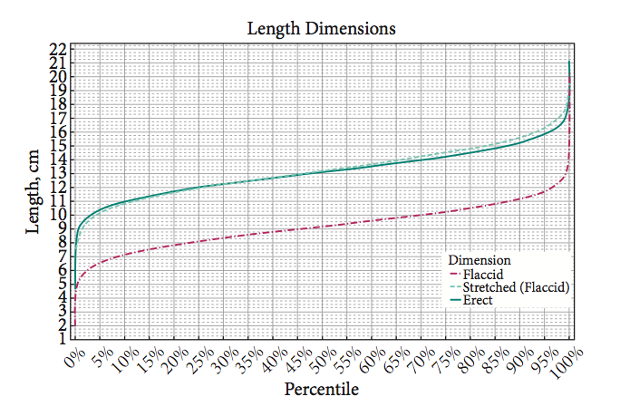
To find these numbers, the researchers examined variables from 20 previous studies on penises (culled down from 96 original studies) to construct a “nomogram,” a graphical representation that’s supposed to include all ages and races of men’s genitalia.

The study is the first of its kind to “combine all existing data on penis length and girth into a definitive graph.” It’ll be used by doctors to reassure men from size anxieties.

Here’s one of the graphs related to penile length:

Penile length graph (The Guardian)

Penile length graph (The Guardian)

However, the researchers have admitted there are some flaws to this study. One is that size differences between the races can’t be compared equally, because the sample sizes of each race were not equal themselves.

And then there’s this flaw:

They acknowledged their results may have been somewhat skewed by the possibility that men who volunteer to be examined may be more confident in their penis size than the general population.

But I’m sure that’s just part and parcel of the entire package (sorry, couldn’t resist). Either way, 97%+ of men can now rest easy.


How Many Wives Cheat?

Woman removing wedding ring (Mockridge Investigations)

Woman removing wedding ring (Mockridge Investigations)

I ran across an interesting article on “The Huffington Post” on cheating wives, and wanted to see what other numbers I could find on the topic.

The 2013 HuffPo piece cites a “Bloomberg Business” article (the link to which is now defunct) that supposedly goes into further detail about it. The findings were apparently taken from the National Opinion Research Center’s General Social Survey, and found that women “had more affairs in the past two decades then in previous years.” The article doesn’t clarify how long the “previous years” timespan is.

But the study apparently found that “the percentage of wives having affairs rose almost 40 percent … to 14.7 percent in 2010.” This seems a little suspect, especially since we can’t see the original source. We’re dealing with self-reporting, so there’s bound to be some wonky numbers. And I don’t understand this “rising 40% to 14.7%” business. I feel like something got lost there, because there’s sort of no way that can be true.

HuffPo’s article mentions that for women, greater economic freedom makes it easier to cheat, since a financially independent woman isn’t trapped by her husband making all the household income.

Another study excerpted from the book “The Normal Bar” puts the number of cheating women at 19%, but this might also included unmarried women. A feature from “Fox News Magazine” claims the number of cheating wives hovers around 50-60%.

But which of these is correct?

It’s pretty impossible to tell. But it’s probable that the actual numbers might be higher.

There are so many varying statistics on this due to self-reporting issues that we’ll probably never get a concrete number of wives who admit to cheating on their husbands.