No Shit: Colleges Are Underreporting Sexual Assaults

UVA Rotunda (Wikipedia)

UVA Rotunda (Wikipedia)

This should come as a surprise to absolutely no one: A recent study published in “Psychology, Public Policy and Law” found that colleges underreport sexual assaults on their campuses.

Conducted by the American Psychological Association, University of Kansas researcher Corey Rayburn Yung analyzed data pertaining to on-campus sexual assault reports from 31 colleges and universities. (This data came via the Clery Act, a federal law that mandates how colleges self-report crimes.) He specifically looked at “large schools with on-campus housing and 10K students” that were audited between 2001-2012 by the U.S. Department of Education for meeting federal reporting standards.

Here’s what Yung found:

During the audits, the reported numbers of sexual assaults increased by approximately 44 percent on average from previously reported levels. After the audits ended, the reported number of sexual assaults in following years dropped to pre-audit levels, evidence that some schools provided a more accurate picture of sexual assaults on campus only when they were under federal scrutiny, the study concluded.

(The study notes that individual stats for each school weren’t provided, and some didn’t show a spike in reporting during this period.)

It makes sense that a school would be more vigilant in reporting assaults during a government-mandated audit. But holy shit that’s a huge discrepancy. (To his credit, Yung did say that the study’s initial hypothesis was that colleges were underreporting these numbers, so he wasn’t going into this super-naive.)

But here’s another troubling thing, taken from the study’s abstract:

The data indicate[s] that the audits have no long-term effect on the reported levels of sexual assault, as those crime rates return to previous levels after the audit is completed.

So these schools are only on top of things when the Feds are breathing down their neck. Basically you’re shit out of luck if you’re assaulted on-campus during a non-audit timeframe, college women.

It’s probable that issues influencing the underreporting are the schools wanting to cover up the assaults (obviously), and/or schools might attempt the resolve the cases in a timely manner during the audit.

This sheds light on how higher education institutions see sexual assault: more of a potential blight on their reputations than actual concern for victims. Said Yung:

The study shows that many universities continue to view rape and sexual assault as a public relations issue rather than a safety issue. They don’t want to be seen as a school with really high sexual assault numbers, and they don’t want to go out of their way to report that information to students or the media.

What happens to schools that don’t comply with the sexual assault reporting requirements? They’re fined $35K, which pretty much amounts to a student’s (or half a student’s) yearly tuition.

I don’t know about you, but I’ve long suspected this to be the case. A similar phenomenon occurs with reporting unemployment numbers: A person who doesn’t work is counted as “unemployed” only if they’ve been actively looking for work within that past four weeks. If they haven’t done so, they’re not counted at all. Whenever a new jobs report comes out claiming that the unemployment number has dropped, a lot of people who haven’t been looking get hopeful and begin to look for work again, and then the real unemployment number grows. (And then everyone wonders why it’s bigger than before.)

To solve this problem, Yung calls for greater resources allocated to the issue, more frequent audits and greater fines for delinquent schools. I’d say that that’s a good step in the right direction.


The Numbers Behind Stanford University’s Sexual Assault Problem

Stanford University (Stanford)

Stanford University (Stanford)

Last week, Stanford University swimmer Brock Allen Turner was charged with raping an intoxicated and unconscious woman in January. Allen was discovered by two men, who then chased after him. The men tackled and held Allen to prevent him from escaping, while a third man called the police.

Since then, Allen has “voluntarily withdrawn” from the university (more likely, it was either that or face expulsion), and won’t be allowed to re-enroll. His profile has also been removed from the nationally-ranked swim team’s website. Stanford will also conduct its own investigation of the crime.

This is notable for a few reasons. Rapes on college campuses have made headlines recently, notably the “Rolling Stone” UVA article, and subsequent fraternity scandal. But this is the first time we’ve recently seen a school take a hard line against rape. The university made a swift and decisive action, leaving no room for public outcry.

Specifically for Stanford, this is a pretty bold move. According to the “SF Gate,” the school has been one of the schools called out for their sexual assault policies (as in, they’re not stringent enough). Stanford Law professor Michele Landis Dauber prepared a report on sexual assaults at the school, and found the following:

Between 1997 and 2009, just four of 175 reported sexual assaults were formally adjudicated at Stanford, with two of the alleged attackers held responsible.

Doing the math, only 2.29% of reported sexual assaults were tried over a period of 12 years. (And, with what we know about the reporting of sexual assaults, it’s probable that the sheer number of them that occurred was much higher.) The alleged attackers were only held responsible 50% of the time. Pretty shameful.

Dauber noted that the numbers have improved since the report: The university has been “more welcoming” to victims and followed through on investigations (which could mean following through on more investigations, and/or following through more closely). But of course, there’s always room for improvement.

Let’s hope that Stanford’s actions incite other colleges to make the right decisions when, not if, they’re faced with similar situations.

Reported vs. Actual Numbers in Same-Sex Attraction

Male homosexual attraction (Science Daily)

Male homosexual attraction (Science Daily)

One of my (many disparate) areas of interest is the concept of stated preference vs. revealed preference. It means that while you may say one thing, your actions may show another thing. “Preference falsification” (term coined by Duke University’s Timur Kuran) relates to this as positing that people aren’t always completely truthful about their preferences in public. (That’s one of the things that interests me about sexuality data: it’s so easy to lie! And nobody could conceivably find out!)

The study was published in 2013 by the National Bureau of Economic Research, and was performed by Ohio State University. It dealt with admitting sexual attraction in standard vs. veiled polls (veiled meaning anonymous).

Participants were asked about their attitudes towards LGBT people and same-sex attraction. With the “normal” poll (i.e. people’s identities were conjoined with their answers), 11% of respondents didn’t see themselves as heterosexual, and 17% admitted to having a sexual experience with someone of the same sex.

But shit got real during the veiled poll. Now 19% of respondents didn’t see themselves as straight, and 27% admitted a same-sex sexual experience. You don’t have to be good at math to see that that’s a large jump for both aspects of the study.

According to the study’s abstract:

“The veiled method increased self-reports of non-heterosexual identity by 65% (p<0.05) and same-sex sexual experiences by 59% (p<0.01).”

The study also found how religion, in this case Christianity, influenced some of the participants’ answers. The veiled approach inflated the discrepancy so that self-reports of non-heterosexuality and same-sex sexual experiences skyrocketed by 100%+ from the usual poll. Talk about underreporting!

The U.S. Abortion Rate Has Been Decreasing Since 2002

Baby (Santa Banta)

Baby (Santa Banta)

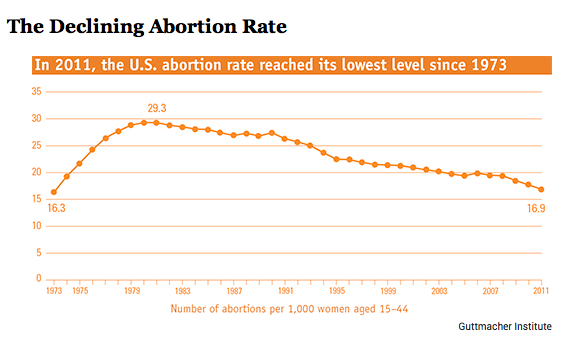
Abortion rates have been falling over the years. The Centers for Disease Control and Prevention (CDC) completed a study last year that analyzed long-term abortion trends, spanning from 1969 to 2011.

The Declining Abortion Rate (The Atlantic)

The Declining Abortion Rate (The Atlantic)

The CDC counted 730K+ abortions in 2011, which works out to 16.9 abortions per 1K women ages 15-44. This is the lowest ratio for abortions since 1973, where 16.3 abortions were recorded for every 1K women within the aforementioned age range. The study’s abstract notes that abortions were highest among adolescents and lowest among women ages 30-39 for the duration of the study. Women in their 20s had the majority of abortions.

Researchers speculate that the decrease in abortions is linked to changing social attitudes about the practice, as well as marriage. When marriage was the socially-acceptable default setting for relationships, abortions were much more rare. But now that marriage rates have decreased, many women are choosing to terminate an unplanned pregnancy rather than have a shotgun wedding with the father.

An article on “The Atlantic” also notes that American attitudes toward abortion have shifted in recent years. While only 20% of the surveyed population would like to see the practice outlawed, 38% surveyed believe it’s “morally objectionable.” This prevailing idea is likely preventing some women from having abortions, and so carrying the fetus the term. It’s very possible that the numbers on abortion are higher than reported, due to any lingering shame or stigma (either internal or external) women who’ve gone through it may face.


Are Male or Female Submissives More Common?

Jamie Dornan as Christian Grey (EW.com)

Jamie Dornan as Christian Grey (EW.com)

In a recent interview with “Elle UK,” actor Jamie Dornan discussed his role in the upcoming “Fifty Shades of Grey.” He will play businessman Christian Gray, who initiates Anastasia Steele (Dakota Johnson) into his world of pleasure and pain.

Dornan described going to a sex dungeon for research and expressed surprise at how large and widespread the lifestyle is. He then claimed that “more men are submissives than women.”

Is this true?

Dornan was probably speaking from his own anecdotal experience of visiting the dungeon. We don’t know if he visited more than one (and where the dungeon or dungeons were located), and so cannot extrapolate any larger trends from his observation.

But a couple of recent studies illuminate how dominant and submissive roles in BDSM break down along gender lines. Naturally, one of the questions asked was how participants self-identify: as doms, as subs, as women, as men.

In 2013, a Dutch study found 33% of the men surveyed identified as submissive, while 48% identified as dominant. Among women, 76% of respondents identified as submissive, and 8% identified as dominant.

Closer to home, a study from Southern California came out, which examined mental health among BDSM practitioners.

Within the study, 26% self-identified as submissive (with 61% self-identifying as dominant). Amongst women, 69% identified as submissive, and 30% identified as dominant.

This might be a stat where the anecdotal evidence differs from the numerical data. The male respondents might not’ve wanted to self-identify as submissive, and so might’ve skewed the data. But that doesn’t mean they don’t exist.

UVA Sexual Assault: Rape Punishments on College Campuses

UVA Rotunda (Hoo Stories)

UVA Rotunda (Hoo Stories)

On Nov. 19, “Rolling Stone” published a harrowing article on a UVA student’s 2012 gang rape, and its eventual social and political fallout and complications around the campus. The article goes into depth in detailing UVA’s culture of avoiding the topic of sexual assault, and terming any assaults mere “bad experiences.”

The article cites UVA’s honor code culture that also functions to keep sexual assault quiet. It points out that 183 students have been expelled for violating the honor code since 1998, but there have been no expulsions resulting from reporting sexual assault (which is arguably more prevalent, from anecdotal data).

This isn’t just a UVA issue. Last year, Yale allowed five students guilty of “nonconsensual sex” to continue their education at the Ivy institution without suspension or expulsion. (The sixth one was suspended and future probation.) Instead, they were given punishments ranging from sensitivity training to a reprimand.

The “Rolling Stone” article notes that one in five women will be sexually assaulted during their time in college, but only 12% will report an assault to the police. So it’s clear that the actual numbers are much higher than those being reported. Hopefully, this UVA case will spur on more open discussions on sexual assault, particularly on college campuses, and urge universities to hand out heavier punishments for assailants.