Sex & The ’60s: Why Did Condom Usage Decline During the Decade?

Vintage condoms (Collectors Weekly)

Vintage condoms (Collectors Weekly)

This week, we’re examining sexuality data from the 1960s, in celebration of the upcoming final half-season of “Mad Men” beginning Apr. 5th.

Everyone knows that the 1960s was a game-changer in terming of blowing sexuality wide open, and that we still feel the reverberations today. But one aspect of sexuality was negatively impacted during that timeframe: condom usage.

But why? It comes down to the economic principle of substitution, which holds that when the price of one good rises, demand for a similar good rises. (Picture coffee and tea in this scenario: If the price of coffee goes up, fewer people will want, or can afford, to buy it, so they’ll want tea.) In the 1960s, other methods appeared on the scene, and they became more popular to use, so the substitution effect took hold. Though price didn’t play into it, the effects were unchanged.

One method majorly stood out. Enovid, the first birth control pill, was approved for use by the Food and Drug Administration (FDA) in 1960. (The contraceptive pioneered by Dr. Carl Djerassi, “the father of The Pill,” later got licensed under the trade name Ortho Novum.) Its popularity grew rapidly: 1.2M+ American women are on it in 1962, and then almost doubles to 2.3M+ the next year.

By the middle of the decade, 25% of couples used it, and 6.5M+ American women used it (but no data on the number of partnered versus single women who used it).

But that wasn’t the only birth control innovation. In 1968, the FDA also approved the first intrauterine devices (IUDs). Unlike today’s common T-shape, Dr. Hugh Davis’s Dalkon shield was egg-shaped with a number of dull spikes emanating from it. Within two years, the IUD had sold 600K+ in the U.S.

With these advances, it’s easy to see that the simple condom would’ve slipped out of public favor.


 

Why Are Condoms So Expensive in Venezuela Right Now?

Condoms (Prevention Justice)

Condoms (Prevention Justice)

Happy Friday!

Apropos of National Condom Week: Would you pay $755 for a box of condoms?

That’s insane, right? But right now, sexually-active and contraception-conscious Venezuelans don’t have much of a choice. That’s how much a 36-pack of Trojan condoms is going for. With the exchange rate, it works out to be $20+ per condom. If you’re shopping around, a 24-back of Durex condoms is selling for $317, making it the (slightly) more economical choice of $13+ per condom. (For context, this is about $10 more than the country’s standard black market rate.)

This is really alarming when you consider that the country’s minimum monthly wage is $888.24.

The Venezuelan people literally cannot afford to have safe sex.

The reason behind these sky-high prices? Oil.

Venezuela exports a lot of the stuff, using it to bring in around 95% of foreign earnings. But oil prices have fallen dramatically recently (over 60% drop within the past seven months), leading to fewer earnings for the country. This, in turn, inhibits Venezuela’s ability to import other basic goods (such as chicken, milk and corn), since their money doesn’t stretch as far. The Bank of America Corporation estimates the the country will import 42% less in earnings than it did in 2012.

Condoms aren’t the only contraceptive that’s hard to come by within the country. Birth control pills are also in high demand, and are very hard to find right now.

According to “Bloomberg Business,” the shortages began in late December, when the Venezuelan government “tightened dollar disbursements amid sliding oil revenue.” The Venezuelan Pharmaceutical Federation offered the following observation:

No condoms were available in 10 eastern and central Caracas pharmacies visited in late January, compared with as many as 20 different kinds available at some locations in November, including Reckitt Benckiser Group plc’s Durex and Church & Dwight Co.’s Trojan brands.

Venezuelan President Nicolas Maduro was attempting to fix this problem before it started: Last June, he announced that the government was building a condom factory to meet the country’s demand. But since then, customers disliked the quality of the condoms, and demand often outpaced supply.

Another factor in this saga is Venezuela’s own sexual health stats. According to a 2012 World Bank study, the country has the fifth-highest number of teen pregnancies out of the 21 Latin America countries. (This averages out to be 88+ live births for women ages 15-19 for every 1K women.) It also has the fourth-highest number of people living with AIDS on the continent.

If this condom (and birth control) shortage continues, it’ll impact Venezuela’s teen pregnancy and AIDS population for the worse. As prices rise, people will become more inclined to completely forgo any birth control method, and the government might not be able to support the overwhelming resulting birth rate. Let’s hope a solution arrives before these things come to pass.

I’m just thankful condoms are not only cheaper than a child, but also cheaper than a month’s rent.

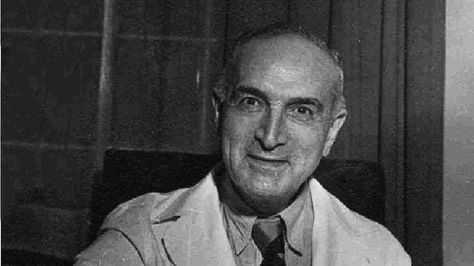
Dr. Carl Djerassi, Father of The Pill, Has Died

Dr. Carl Djerassi (Rutgers News)

Dr. Carl Djerassi (Rutgers News)

Modern contraception pioneer Dr. Carl Djerassi died last Friday in San Francisco. He was 91 years old, and had suffered from complications of liver and bone cancer.

Often called the father of The Pill, Djerassi found an essential component of the now-common family planning product. In 1951, while working as a researcher at Syntex in Mexico City, he and two others successfully synthesized norethindrone, a progestin that later provided the base of the modern birth control pill. Djerassi and his team received a patent for their discovery.

Initially, the scientists thought that norethindrone would help fertility, but they soon realized that it served another purpose. The team knew that progesterone inhibited ovulation during pregnancy. They modified the progestin’s basic structure and added ethisterone, a compound thought to be devoid of medical value. (Warning: science-speak ahead.)

Djerassi’s team found that they could change the structure of progesterone to increase its potency eightfold. This progesterone analogue was strong enough to work when injected, but lost its potency when administered orally…Djerassi’s group made the same chemical modification in ethisterone that they had earlier made in progesterone.

(Interesting side note: At the time, Djerassi wasn’t researching anything to do with conception when he and his team made his famous discovery. He was actually looking for a compound that could be used to treat cancer. Happy accident, as they say.)

After five years of clinical trials, the birth control pill began reached the mass market, and cracked 1960s sexual norms wide open. (And we’re still feeling the effects of it today.)

This wasn’t his only big discovery: Djerassi also patented the first antihistamine, the drug that prevents allergy symptoms.

During his lifetime, Djerassi received 34 honorary doctorates. He was also the recipient of the National Medal of Science for chemistry in 1973, and the National Medal of Technology and Innovation in 1991. The two awards are the U.S.’s highest science and technology honors, respectively.

In addition to his scientific accomplishments, Djerassi also wrote plays (some performed off-Broadway) and science-fiction, founded a company to control insect growth, and started an artists’ colony in his property in California.

Dr. Djerassi’s contributions to family planning were, and continue to be, a boon to women the world over, and his work will continue to hold great value for the coming generations.

Thank you, Dr. Djerassi. Thank you.


#ThrowbackThursday: Margaret Sanger’s Birth Control Clinical Research Bureau, 1923

Margaret Sanger's Birth Control Clinical Research Bureau (BCCRB) (The Margaret Sanger Papers Project)

Margaret Sanger’s Birth Control Clinical Research Bureau (BCCRB) (The Margaret Sanger Papers Project)

I found this photo on The Margaret Sanger Papers Project. One post notes that Sanger founded America’s first legal birth control clinic on Jan. 2, 1923. By the 1930s, the Birth Control Clinical Research Bureau (BCCRB) served 10K+ patients per year, and “trained thousands of doctors and nurses.”

In the undated photo above, a nurse teaches other women…I assume birth control and/or family planning. I can’t say definitely if they were doctors, nurses or patients, but I’m confident they received the most accurate information of the day.

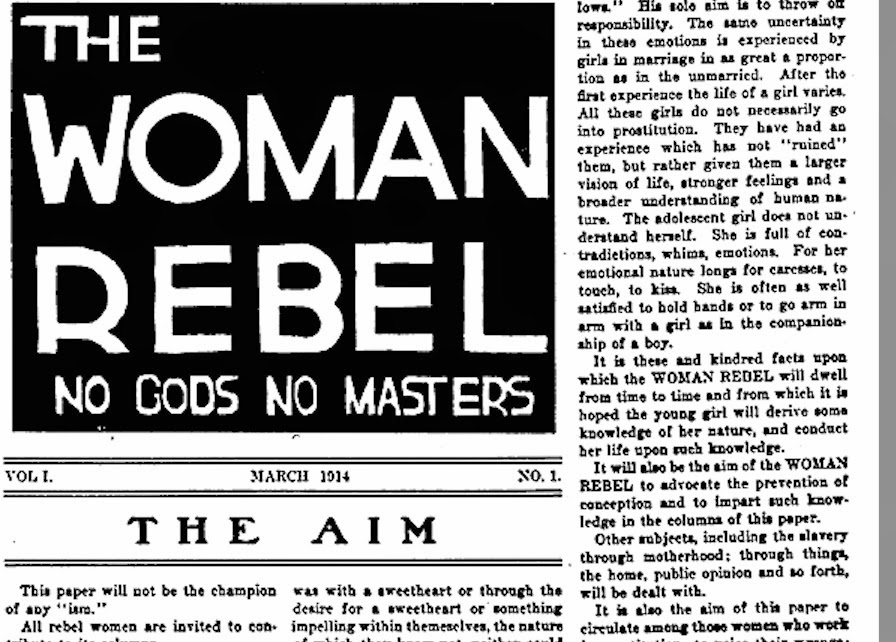
#ThrowbackThursday: Margaret Sanger’s “The Woman Rebel”

'The Woman Rebel' Volume I, Page 1

‘The Woman Rebel’ Volume I, Page 1

One hundred years ago, Margaret Sanger launched “The Woman Rebel,” a monthly newsletter that promoted contraception. (Tagline: “No Gods, No Masters.”) The newsletter popularized the now-common term “birth control” (the popular euphemism of the day was “family limitation”), and proclaimed that “each woman should be the absolute mistress of her own body.” Obviously, Sanger was way ahead of her time.

Seven issues were published before Sanger was indicted on violating postal obscenity laws in August 1914 (at the time, it was illegal to send obscene materials by mail). But this was part of her plan: Sanger wanted to provoke a legal challenge to spreading information about birth control by mail. Once indicted, she fled to England, while prepping “Family Limitation,” a more radical approach to birth control. The birth control cause stole the spotlight the next year when her estranged husband was thrown in jail for giving a copy of “Family Limitation” to a representative of anti-vice crusader Anthony Comstock.

Though Sanger’s ideas were inflammatory at the time, they laid the groundwork for modern feminism. And thank God for that.

Will In Vitro Fertilization (IVF) Replace Sex?

Couple in bed

Couple in bed

Dr. Carl Djerassi recently predicted that sex would become purely recreational by 2050 since so many women are having children via in vitro fertilization (IVF). But do the numbers bear this out?

Earlier this year, the Society for Assisted Reproductive Technology released a report examining success rates from many IVF clinics. The report revealed that in 2012, IVF clinics performed 165K+ procedures, out of which 61K+ babies were born. Therefore the year had a 37%+ success rate. Two thousand more babies were born in 2012 than in the previous year, and 2012 also had the highest percentage of babies born through IVF thus far.

Dr. Djerassi also remarked that advances in IVF technology will allow parents without fertility problems to consider the procedure. This would, in turn, free up the potential parents (and everyone else) for consequence-free sex.

And Dr. Djerassi would know about recreational sex: In 1951, he helped invent The Pill.

#ThrowbackThursday: Ernst Grafenberg

Ernst Grafenberg

Ernst Grafenberg

German doctor and scientist Ernst Grafenberg was born on Sept. 26, 1881. (If he was still with us, he’d be 133 years old.) His contributions to sexual research include creating the first intrauterine device (IUD) in 1929, then known as the Grafenberg ring, and research into how women’s urethras play into orgasm.

But his name is more famously associated with the G-spot, G as in Grafenberg. The G-spot was given his name in 1981.